Sunday, July 03, 2016

Traveling in Northern Europe- Scandivavia

My family (father's side) originated in Prussia which doesn't exist anymore. In fact, in that part of the world, several countries have at times been major empires and at other times have disappeared from the map. The history is long (800+ years of well recorded history), complex (independent for only the past 25 years, at the crossroads of invasions from many directions in the past), and the people are still recovering from atrocities in WWII and domination by the USSR until the 1990's.  Not your typical tourist destination, but very interesting.  If you are headed in that direction, including a visit to the Scandinavian countries is convenient and worthwhile.

With all this in mind I planned a four-week trip.  So much information is available on the internet. Additionally, I read some history and current events; where can our time best be spent?  Even with four weeks, it is only time enough for a brief sampling of what the region has to offer.  First, I booked the international flights; we would arrive in Oslo and depart from Berlin. These cities allowed me to book our flights using only airline frequent flyer miles.  Adding Bergen, Stockholm, and Helsinki were easy choices.

Our Baltic destinations were harder choices. I wanted to be able to drive and experience the countryside. My notes suggested that the eastern parts of some of these countries were still undeveloped for tourism: roads, language, accommodations; too questionable for such as us, being completely unfamiliar with the region.  But I wanted to see Narva, on the historic border with Russia where battles had been fought for centuries. Tallin is the capital of Estonia while Tartu is the location of Estonia's major university. Riga is the capital of Latvia. Vilnius is the capital of Lithuania and Klaipeda is its major seaport. That leaves out several other attractive choices, but I didn't want a hectic schedule.

Our flight to Oslo, with stops in DC and Manchester, was uneventful. The airport is 30 miles out of town, but, with some help, we managed to buy tickets and board the proper train. Our hotel was a short walk from the train station. Oslo is pretty and a very walkable city; we took advantage of it. Cafes in the pedestrian district, parks, museums, ferry boat rides, and upscale neighborhoods; we stayed busy. One evening we came across a food festival where merchants were giving out samples of many different dishes, enough to provide our dinner. At this time of the year, darkness only lasts about 4-5 hours; sunset at 11pm.  Vigeland Park on the west edge of downtown is a huge complex including playing fields and 600 statues, all nudes.  The preserved Viking ships are also amazing to think of the excellent craftsmanship with only crude tools.


From Oslo we took the scenic train through snow-capped mountains to the coastal city of Bergen. Bergen, an ancient seafaring port, is the gateway to the fjords. Naturally we took a day trip into some fjords and enjoyed seafood dinners. Bergen is said to be the rainiest city in Europe, and we had drizzle one day, but were still able to take a cog railroad to a peak and walk to overlook the harbor.


From Bergen, we flew to Stockholm. The airport is 26 miles out of the city; we stopped at the Tourist Information booth to learn where to buy tickets and which commuter & subway trains to take to our destination.  A bit of a challenge in an unfamiliar city of two million inhabitants and signs in Swedish; their public transit system is complex and all encompassing.  The city is spread across 14 islands.  We travel light with no checked bags, so it is easy to bring our small suitcases onto the trains.  With many high rise apartments, Stockholm is densely populated; we seemed to be in crowds wherever we went, but, of course, we were seeing the tourists sites along with everyone else.  One afternoon we traveled to Sigtuna, a coastal village about 35 miles SW by train & bus, which was scenic but still had many tourists.  The exhibition of the ship Vasa, which sunk almost 400 years ago, is a worthwhile event to include on your list (of course, I am a boat guy).


From Stockholm we boarded an overnight ferry to Helsinki. Our overnight cabin was large and had windows looking out over the bow, but with 2000+ passengers it was a cattle herd when boarding and debarking. Helsinki is nice, with numerous islands along the shore and parks within the city, but no real "old town" because its growth is comparatively recent. The weather was warm, mid 70's, and the parks, beaches, and outdoor cafes were full of people.  Thousands of boats were out on the water. We enjoyed a military marching band as well as a free evening band concert in a central park. Our hotel was across the street from National Security HQ and there was a meeting going on, so security was high.


Finland is located in the same latitudes as Alaska, and is populated by a rugged people, a place where grandmas go moose hunting in the forest. A knowledge of history helps to appreciate the present. Before WWII, Hitler signed a secret pact with Stalin initiating conflict in this area.  Thousands of Finnish children were sent to Sweden to live with Swedish families and be safe from war.  A significant number did not have parents to come back to.

Today all students are required to learn three languages: Finnish, Swedish and a third choice which is often English.  The Finns, with the help of German arms, were able to stop the Russian army, but, at the end of WWII, part of Finland was awarded to Russia.  After a few days we took the fast ferry to Tallin, Estonia.  The ferry dock was only two blocks from our hotel, a short walk.


Friday, March 18, 2016

A Weekend in Ireland

Dubrovnik was the primary destination of our entire trip.  We had been traveling for twenty days and had another stop planned; yet we were sad to leave Croatia.  It meant that our trip was nearing its end.  Next stop Dublin, Ireland.  We had been to Ireland before and enjoyed it; now it would provide a weekend break in our long flights home to Denver.

We arrived late Friday afternoon, just time to rent a car and find our hotel.  The plan was to head out Saturday morning taking the "scenic route", instead of the main highways, to visit attractions in the nearby mountains.  In Ireland they drive on the left side of the road with the driver on the right side.  That means the gear shift (manual trans.) is on your left.  Roundabouts replace intersections.  The road signs are unfamiliar or worse, written in Gaelic.  All these changes are unfamiliar and counter to habit but can be mastered with some concentration.


What we discovered was that we couldn't handle the "scenic routes".  "Scenic route" translates to a narrow winding road with no shoulders to pull off onto.  The edges of the road are marked by low stone walls, the edge of a bridge, or dense shrubbery.  Passing vehicles serve to trim the shrubbery and keep it from overgrowing the entire road (above us trees often closed over our view of the sky).  Vehicles coming from the opposite direction would suddenly appear from an obscured corner ahead hurtling at us at seeming high speed (45mph) while I struggled to stay on the left side of the road center line, and Dawn watched our left rear-view mirror brushing against passing vegetation.  It felt like a distorted road race video game but with no chance to hit reset; instead, the consequences of a miscue would be very real. 

We finally reached our destination park and a parking lot!  After a nice walk in the Wicklow Mountains, we set our course for the nearest major highway and headed back to our Dublin hotel, thoroughly humbled.  A visit to the hotel bar steadied our nerves.  After that we stayed on major roads and began to relax and feel more confident.  Hotel staff were sympathetic and suggested closer destinations.  Dublin has an amazing park, the 1750 acres of Phoenix Park.  This park has a zoo, athletic fields, trails, concerts, marketplace, and guest quarters for visiting dignitaries (including Obama).  We enjoyed a nice lunch at the farmer's market.  We returned our rental car at the airport on Monday morning, fortunately with no damage, and were on our way to Toronto and onward.
             

Sunday, March 13, 2016

Dubrovnik and Montenegro

We had previously visited Dubrovnik in 1990, shortly before the Balkan war began.  Dubrovnik, as a designated World Heritage site, was expected by many to be excluded from the conflict at the breakup of Yugoslavia.  Instead, the Serbs attacked and laid siege to the city by land and sea for nine months.  They had artillery on the mountains overlooking the city, and it suffered considerable damage.  We wanted to know more about Dubrovnik and how it had been re-built.


Following GPS directions into Dubrovnik, we found our small boutique hotel, overlooking the ocean and only a few minutes' walk from the walled old city.  We rented a parking space across the narrow street from the hotel.  Below is the view from our hotel looking toward the walled city.

Dubrovnik is amazing: a history rivaling Venice, a picturesque location between mountain and ocean, stone buildings and cobblestone streets 500+ years old, tall and impressive walls of the old city itself, the many shops and eateries, and the crowds of tourists from everywhere.  Get up early if you want to see the city before the streets are engorged with tourists.  Notice in the photo below that the beach chairs are vacant; only at sunrise is that true.

 An island, easily reached by a short ferry-ride, brings you to multiple beaches, a garden, natural pools and the architecture of the building complex shown below.

  A passenger ferry is available for trips to a park-like island just offshore.  A gondola is available to take you quickly to the top of the mountain overlooking the city.  A very impressive museum, located in the bunkers under Fort Imperial at the peak, details the recent war through multi-media.  Avoiding the crowd, we frequented a little restaurant outside the south gate of the fortress.  There we talked to a server who had been in Dubrovnik through the war.  He said the war "took" his teenage years, age 13 to 20.  A museum inside the old city commemorates all the defenders killed in the war.  Not really trained soldiers; mainly just young men with rifles who decided to defend their city.

Produce displays being set up in one of Dubrovnik's inner town squares.

While staying at Dubrovnik, we took a day trip to Montenegro, to the old town of Kotor.  Montenegro is a socialist/communist country; a resort destination for rich Russians; many signs are in the Russian language.  Kotor is another old walled city, but, in Montenegro, merchants don't scrub the cobblestone streets in front of their shops like Dubrovnik.  Everything looks slightly shabby and unwashed.  Traffic is horrific and unorganized; parking is difficult.
   Notice how the walls of this old city extend far up the mountainside in the background.

Friday, March 11, 2016

Split to Mali Ston

Croatia has many coastal islands; in a two-week sojourn, we only had time to sample a few locations.  We drove south to the city of Split, passing by Zadar, Krka National Park and a host of other interesting places.  Split is not just a tourist destination, but an important commercial and transportation center.  As such, it is quite congested (did I see smog?); we were glad for the GPS in locating our B&B and parking the car.  We were able to walk to the harbor to get a ferry ticket for the following day, visit Diocletian's palace (a Roman emperor who lived over 1700 years ago), and then walk to the oceanfront beach and find a recommended restaurant.  Our server was super; a man of about 50 y.o., who seemed to know every ingredient of every item they served, he understood my lactose condition and was able to quickly suggest alternate ingredients.  Throughout the region we found that servers and chefs were ready to alter any recipe for our individual needs.  A great dinner served outdoors on a patio elevated on a low cliff overlooking sunset on the ocean; this is what vacations are for.

The yacht "A" at anchor off of Split.  This yacht travels the world, and it is said that the Russian owner is building a larger sailing yacht.

The quiet cove where our hotel was located.  We were away from the congestion of downtown; our hotel had a small restaurant (with excellent meal options) right on the beach.


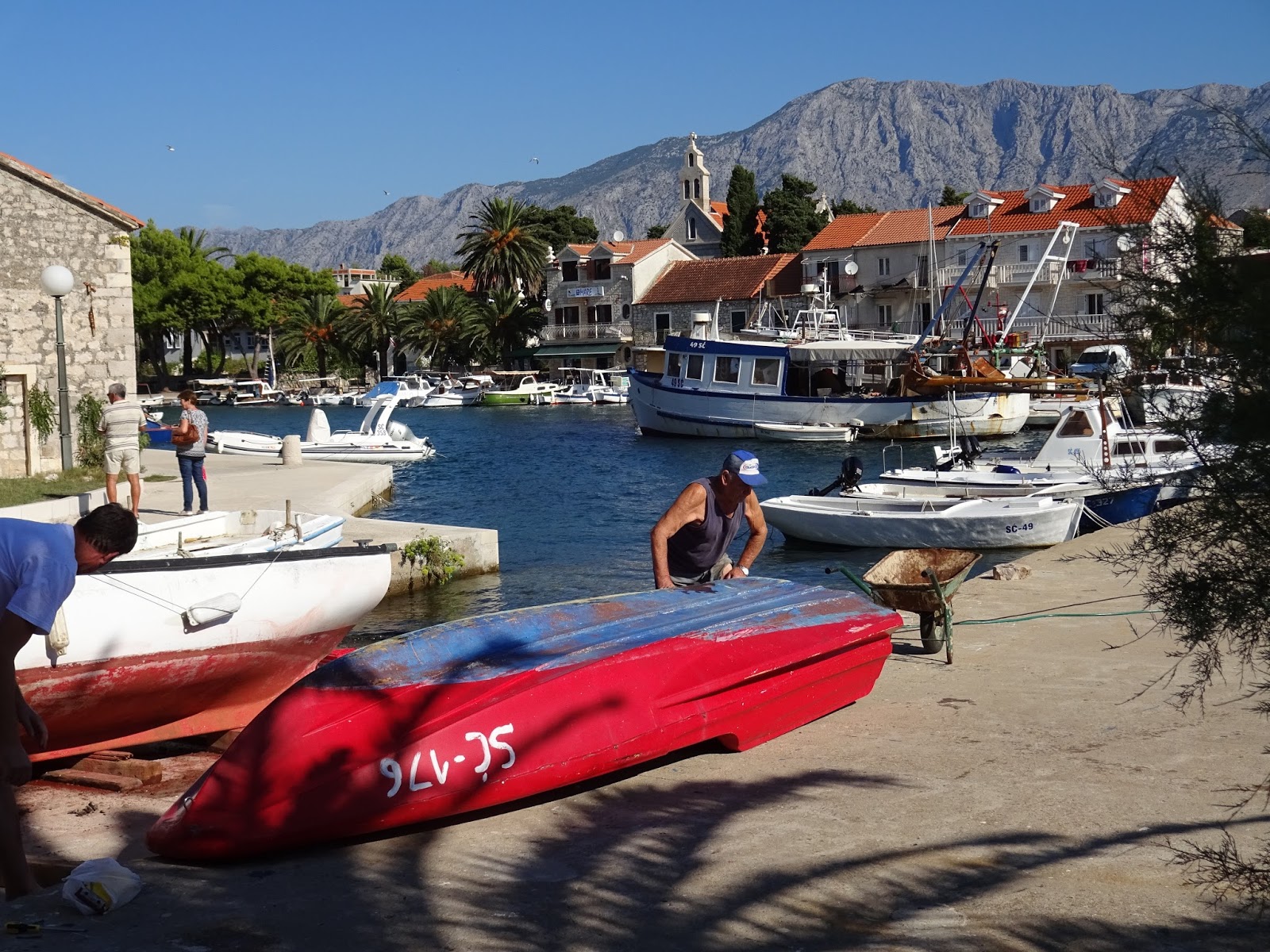
Above: 1. The harbor of Hvar as seen from the fortress above.  Many fancy yachts and a busy nightlife during the yachting season.  2. An outdoor boat repair shop in Sucura.  The mountains in the background are on the mainland.
Sunset at Hvar.  A cruise ship leaving harbor, and local boats tidying up for the night.

The ferry to Hvar was uneventful, other than spotting a world-famous yacht, "A", built at a cost of $300 million by a Russian billionaire.  The town of Hvar is located on the island of Hvar.  The island is a wine-growing center; the town is a yachting center.  Overlooking the city is a fortress which provided protection for the citizens when the Ottoman fleet stopped here on its way to the Battle of Lepanto in 1571 (historic battle between Christians and Muslims for control of the Mediterranean).  The town is scenic, accentuated by beautiful yachts and a long promenade to view them from.  We drove the length of the island to Sucura and took a shorter ferry ride back to the mainland.


History is everywhere in this region.  Why do you drive through a narrow bit of Bosnia-Herzegovina dividing Croatia as you drive toward Dubrovnik?  Because of a treaty signed centuries ago.  Dubrovnik was bordered by the Ottoman Empire to the south and threatened by the city-state of Venice to the north.  Solution: grant a piece of land north of the city to the Ottomans so an attack from the north would challenge the Ottomans before reaching Dubrovnik.

After passing through the Bosnia corridor, we stopped in the village of Mali Ston for lunch.  The village is unimpressive at first appearance, but the restaurant and bay view were excellent.   Nearby is a massive wall across the Peljesac peninsula worth viewing.  


Sunday, March 06, 2016

Istria and Plitvice

 We drove through a localized blinding rainstorm to reach Trieste, which was fortuitous.  The rain stopped just as we arrived, and the city streets, plaza and parking lots were EMPTY!  We took off our shoes and walked through the shallow puddles to view the area.  This central plaza is one of the largest in Europe.

Just as the Danish love their bicycles, the Italians love their motor bikes.  A flooded street in old town Trieste.

Nudism is very popular in this area, thousands of people and entire resorts.  These are tourists, not locals.  More Germans than any other country; an easy trip to get here. 
 
Driving south from Trieste, you quickly re-enter Slovenia and pass through to Croatia, on the Istrian Peninsula.  It is the warm Adriatic coast, a very popular tourist area, particularly with Germans, and favored by many nudists (google FKK).  We stayed on the central coast in Porec.  A little hotel (really a B&B) in a residential area only a few minutes' walk from the harbor.  The host, when he found out I was lactose intolerant, went to the market and came back with more lactose-free breakfast items than I could eat in 1-2 weeks.  All these small coastal cities are incredibly old, ancient cobblestone streets, and stone buildings.  Wine and fresh fish in a restaurant overlooking the harbor; a daytrip by boat down the coast to Rovinj; some local shopping and sight-seeing; it is a relaxing way to spend a few days.

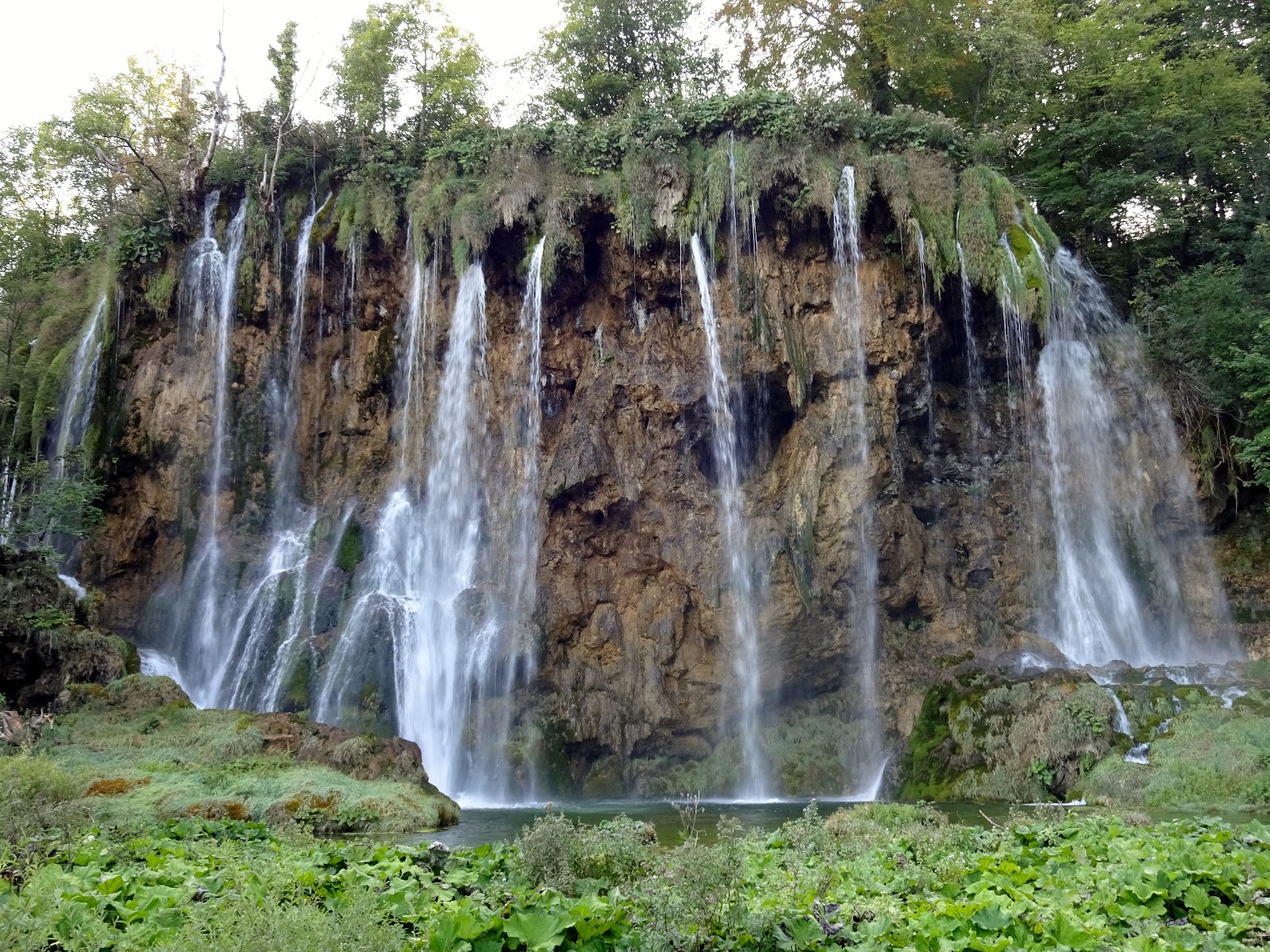
Plitvice Lakes National Park has so many waterfalls that you lose count.  The underlying geology is sponge-like rock which collects the rain and keeps the water flowing.  Didn't see anyone fishing, but fish are plentiful.  Only part of the park is open to view.


From Porec we headed inland toward Plitvice Lakes National Park, an easy half-day drive.  This is different territory.  You start to see the damage of war; bullet holes, damaged buildings, homes never re-built.  This is where the real struggle over failing Yugoslavia started.  Neighbor against neighbor.  We stayed in a B&B within walking distance of the park.  The owners told us that they had to flee in September 1991; went to Italy and didn't come back for seven years.  The house was gone when they returned; done by neighbors.

Everyone had lost family members.  Many would never know what had happened to their loved ones.  And yet everyone we met was so educated, open, reasonable.  The Park is one of the world's wonders; featured in many remarkable photographs.  Imagine hundreds of waterfalls, dozens of lakes, clear mineral-tinted water. And thousands of tourists from all over the world; many standing in your way trying to get a "selfie" while blocking your view of the great features behind them.  Truly amazing landscape and yet how many waterfalls can you see before they start to look the same?  We headed south.     

Slovenia

The drive from Zagreb to Ljubljana is less than two hours.  Slovenia uses the Euro currency; Croatia has their own currency, but most merchants appreciate credit cards, so it makes little difference.  We had rented a VW Sportvan with "Blue Motion" technology and GPS.  This was a very fuel-efficient, autobahn-capable, compact vehicle.  The GPS was invaluable in finding some of the small B&B-style accommodations we had reserved for our trip, given that they were located in the narrow streets of old-town neighborhoods.  Crossing the border into Slovenia, we needed to stop and buy a sticker to show we had paid our highway-use fee.  I had made reservations at a boutique hotel on the west side of Ljubljana, convenient to the old central city and also highways to further destinations.

Ljubljana is in a valley with a river running through it and a castle overlooking it.  The castle is surrounded by parkland.  Along the river are many restaurants and ice-cream shops.  The entire country is compact enough that you can get anywhere in Slovenia from the capital within about two hours.  The Alps are at the northern border, and the ocean is a short drive west.  The country is heavily forested; our cave tour guide said she often has bears in her yard.  When it rained one day, we toured a cave (one of many) in the morning, and then, when it cleared in the afternoon, we drove to Lake Bled in the Alps.  We had time to take side trips to Austria (the autobahn there is amazing, long tunnels through mountains, long bridges spanning valleys, use fees required) and to Trieste, Italy.  If you are interested in history, find out how many different countries have claimed Trieste in its past.

Extensive caves are found in southwest Slovenia.  They stretch long distances underground; if your lantern were to go out, you would probably never find your way out.  There are underground lakes; when it rains, the lower tunnels fill up and a roaring sound can be heard as the water flows through the complex of tunnels.

 This is a popular view of Hallstadt, Austria.  Picturesque, between lake and mountains, but very touristy.  We were held up leaving because a head-on auto accident had occurred on the narrow mountain road leading into town.

The river flowing through Ljubljana; many restaurants along its banks.  We took a boat ride through the city.

Chapel on an island in Lake Bled.  A castle overlooks the lake, and mountains surround the valley.  Again, very touristy; you know a place is touristy when you can't find a place to park, or the parking is distant and pricy.
We found Lake Bohinj to be a better place to stop, further up the valley, less crowded, and more walking paths.

Arrival in Zagreb

Zagreb was a surprise.  We were expecting this drab Soviet-era, crowded, inland city with dowdy old buildings.  It hadn't been recommended very highly in the tour guides; "if you have time" sort of a ranking.  What we found was a vibrant, beautiful city with many parks-trees-flowers.  Many outdoor restaurants and being the capital and a university town added to the high activity level.  We witnessed a large protest gathering from people demanding more bicycle paths.  The university doesn't have a separate campus; its buildings are scattered throughout the city.  Our hotel had the perfect central location across from a big park.  We enjoyed several different scenic walking routes.  A mountain with ski lodge and hiking trails is north of the city, and a substantial river defines the southern border.  South of the river is somewhat ugly; that is where the Soviet-style concrete apartment houses are located.  The countryside in northern Croatia is scenic: mixed crops, vineyards, orchards, pastures, forests, rivers all in good proportion.  Old castles are somewhat common.  Long-ago, the Christian crusaders passed through this area.  At one castle, an antique sports car show was held outside while people inside with medieval costumes were hosting a festival.  We ate at a recommended outdoor restaurant sited alone on top of a hill; the scenery was great; the food, disappointing.


Flight stopovers: Keflavik & Copenhagen

Iceland seems to be a somewhat new travel destination; perhaps encouraged by a good stopover location and cheap Icelandair airfares.  The airport is modern and busy.  We stayed in a B&B on Keflavik harbor.  No currency exchange was necessary; a credit card (with no foreign currency fees) worked everywhere.  You can see the usual tourist destinations by renting a car.  The driving is easy: uncrowded roads, light traffic, decent signs.  The scenery is worthwhile; volcanic lava beds, lush green valleys, low mountains, glaciers, rushing rivers, lakes and waterfalls.  The Icelandic people must be a hearty bunch.  We witnessed an outdoor carnival being held near our B&B while the weather was in the 40's (Fahrenheit) with light wind & rain, and crowds of people were enjoying the rides even after sunset.  The Blue Lagoon was less than we expected, but Gullfoss was an impressive water feature.


 Copenhagen is such a great city.  It has millions of bicycles, miles of pedestrian-only streets, thousands of boats along its canals and sea front, great public transport, and it is so welcoming, civilized, and historic.  Unlike many old European cities, it didn't need to be rebuilt after WWII.  We stayed in a commercial hotel with a free shuttle to the airport and easy connection to the metro.  Many open areas nearby for our daily walks.  Walk, take a ferry or metro to anywhere in the city.  Visit the Little Mermaid or Tivoli Gardens; many other attractions.  We did get some local currency to use buying food from street vendors.  It is very cosmopolitan; people from many origins feel at home there.  One of our servers was from Argentina and was taking Danish language lessons.  Another man we met was headed back to visit to his relatives in Istria.  We are so fortunate that English is the universal second language.


Sunday, February 28, 2016

Croatia Preview

 Our hotel on the island of Hvar.  Right on the Adriatic; nice swimming once past the pebble beach.

 Zagreb city plaza at night.  The capital; a university town; many outdoor restaurants and parks.

A park across the street from our hotel in Zagreb.

Thursday, February 18, 2016

Travel blog; a re-purposed website

                                                                 Sunset at Hvar.

This blog originally started as a place to record thoughts and experiences concerning my boat designing & building hobby.  As the years went by, the boats I built got increasing complex and expensive.  Completion of my 8th boat was about a $20K endeavor, and amateur-designed, home-built, wooden boats command very little resale value.  My current boat (an 18' runabout for water skiing) functions well; thus, I have no logical reason to part with it and build another.  Update: I am now building boat #13, but these more recent designs have all been row boats or kayaks which are much less expensive.  I love the challenge of design and building these nautical structures with all curved surfaces.  These are explained in a newer blog:  developable-surface-boat-designs.blogspot.com.

As a result, the time previously spent on planning for a possible new boat has now been re-directed to planning new vacations.  Today, with the internet, there is nothing a travel agent can do that you can't do yourself.  A trip can be customized to the price range, destinations, time allotment and pace that you desire.  You can explore accommodation alternatives, transportation schedules, local activities, whatever your interest.

After a career in the US military, living overseas for nine years and visiting many countries, Dawn and I did not do much traveling for several years after settling in Colorado.  Colorado itself was new to us.  Then we started a few years ago (2010) with trips to Victoria, B.C., Spain (Barcelona and Costa Bravo), Turks & Caicos (nothing but beach) and Hawaii (western Maui).  Next, we got more ambitious with separate trips to Costa Rica, Ecuador & Galapagos, Panama, and Belize.  Each trip proved to be a real adventure.

In Costa Rica, we rented a car and drove first to the coast for some snorkeling, then drove (narrow, winding roads) to the volcanic interior mountains for some zip-lining and hiking.  When in Ecuador, we had to do some quick shopping in Guayaquil when the airline lost Dawn's luggage; then it was on to a memorable snorkeling tour of the Galapagos islands.  In Panama we experienced the growth and prosperity of Panama City; revisited our old home and the ruins of Spanish forts on the Atlantic coast; and went snorkeling from remote Bocas del Toro. In Belize we swam with sharks and stingrays as the guide chummed with fish parts over the side of the boat near us.  Last Spring, I planned a September extended European trip for us.  At Christmas we went to the Yucatan in Mexico and swam (and hiked) in underground caves, "cenotes".

Our goal in Europe was to re-visit Dubrovnik, Croatia (first visited in 1990).  The history of the Balkan area is complex and worth studying.  Being able to see it and listen to the experiences of people living there made it come alive.  The first step in planning the trip was to book the international flights.  What I discovered was that substantial money could be saved by booking separately for each airline and flight.  Booking through one airline we were quoted about $7000 for airfare from Denver to Dubrovnik and return.  Booking through multiple airlines with added stops, the total cost was reduced by half.  Thus, we flew to Iceland and stayed there for 2 1/2 days; then we flew to Copenhagen and stayed for 3 days; then we flew to Zagreb and picked up a rental car.  For the next two weeks we wandered through Slovenia, made side trips into Austria and Italy, then re-entered Croatia and, after four more stops, arrived in Dubrovnik (made another side trip to Montenegro), and finally flew to Dublin, Ireland for a three-day visit before flying home.

Everything went absolutely perfectly.  We stayed in some four-star hotels and some simple B&B's; whatever placed us in the location where we wanted to be (usually within walking distance of the old city center or other attractions).  Most of the hotels were small; some with less than ten rooms. The roads were excellent.  The restaurants catered to my lactose-intolerance.  The ferry boats (3) were on time.  The costs were moderate.  It was attractive enough that I could see myself living there.  It felt like Germany except less expensive and with better weather.

Dawn says the "bar" has been set so high that future trips may not compare.  I've taken that as a challenge.  We are now scheduled for four weeks total to fly from Denver to Oslo; take a train over the mountains to Bergen; boat trip to the fjords; fly to Stockholm; overnight ferry (with cabin) to Helsinki; ferry to Tallin, Estonia; car rental for two weeks to wander south through Estonia, Latvia, and Lithuania; fly from Vilnius to Berlin; and then fly back to Denver.  By careful planning, our flights from here to Oslo and Berlin back to Denver will be courtesy of frequent flyer miles. Our five-star hotel in Berlin will be inexpensive due to Expedia points accumulated (although I prefer Booking.com for Europe).  The Scandinavian cities are expensive, but much less so when you book hotels on the internet rather than through a travel agent.  The Baltic countries are a travel bargain.

We leave in late May.  As the trip progressed, I intended to use this site as a travel blog with photos but transferring photos from my iPad has proved difficult.  Instead, I'll update this site once we are back home.


List of Travel Entries, June 2026

 Entry titles are listed in order from oldest to newest (top to bottom) in this index; however, the actual blog entries are posted from olde...