Sunday, May 15, 2022

The Island of Roatan


Looking at Puerta Azul from the beach.  Enough tropical forest for you?  There are about seven buildings on site (a main lodge and guest cottages).

Looking out toward the dock and reef.  The "puerta azul" or blue door is the entrance to the long dock.

We are told that we are visiting Roatan at the start of their warmest season.  Makes sense due to the sun being directly overhead on its way north until June 21.  Our rented house here is fully air conditioned; however, at the windows we have screens and wooden shutters, no window glass. Thus, we have the choice of A/C and no light from the windows (closed shutters), or light but no effective A/C.  Still, we have two bedrooms, two bathrooms, living room, and a basic kitchen to enjoy.

It reminds us of our time living in Panama. Tropical nights are long year around; sunrise is announced by the crowing of chickens, the cooing of pigeons, and the bleating of goats (from nearby “farmlets”) before the sun actually appears.  Dense tropical vegetation delays the morning sun even longer. 

A sample of staghorn coral.  There were simply too many types of coral to capture them all.  There were large fields of fan coral, some of an intense purple color.  There were huge formations of brain coral also.  Some areas looked like an underwater forest of small trees.

I caught this fish out in the open where it couldn't hide.  Before we got to the reef, we had to cross a field of sea grass.  I saw a large stingray there but was unable to get a photo (first day out wearing those crappy short fins).

Roatan is still very much part of a third world country.  It was in evidence during our drive from the airport and also at a visit to our nearby bodega.  When I first stopped here, 42 years ago, English was the almost universal language. However, Honduran mainlanders noticed that this island was relatively more prosperous due to tourism and have moved here in response.  Now, Spanish is a strong second language here; combined with more congestion and the loitering of those still seeking employment.

The big reason to come to Roatan is for snorkeling or scuba diving.  Our hotel/lodge is set up for excellent access to snorkeling at the reef just offshore.  Other accommodations favor the scuba diving tourist.  The western half of this island is somewhat developed while the eastern portion is usually visited on a powerboat excursion.  The reef here is part of the second largest reef worldwide, the Mesoamerican Reef which stretches about 700 miles from northern Yucatan to the Honduran Bay Islands.  The snorkeling may be the best in the Caribbean.

This was one of the first fish we came upon.  I took 100+ photos but will post only a few samples of what we encountered.

A small sample of fan coral on the edge of a deep drop off.  I have never been attracted to scuba diving: more equipment, air refills, and it gets colder and darker as you go deeper.  The most colorful coral seems to prosper in the sunlight nearer to the surface.

We bring our own snorkels and masks; ours are simple snorkel tubes with no valves to complicate things.  Let the snorkel fill with water when submerged to reduce buoyancy.  I want no air restriction and perfect reliability; our snorkels are 40+ years old.  Not all faces are the same shape, and a leaking mask from a poor fit or a rim seal which has lost its pliability can ruin a trip.  I think that Dawn's mask is ready for replacement due to reduced pliability in the rim seal.  You want a wide-angle, close fitting, low volume mask with a soft (usually silicone) rim seal and a soft nose covering.

Good swim fins are harder to transport; physics dictates that the fins must be about two feet long (longer is better) to provide efficient thrust from your legs.  Shorter "travel fins" are sold but are definitely inferior.  The fins our hotel initially rented to us were crap.  Instead of imparting a "wave" motion, it was more like a "barndoor" motion. We exchanged them for longer fins which were many times better.  Still the fins need to fit your feet.  I have wide feet which resulted in sores from pressure points; it is the first time I have had that problem.  We used to have our own fins when we lived in Panama.  I really don't want to have to add them to our luggage.  We had no checked luggage for this trip; makes for a quick departure.  We have experienced lost checked baggage in the past.

Larry floating near the surface.  He and his wife, Janet, are harder core snorkelers than Dawn & I.  They got up early to get in one last snorkel.  We slept in.

Dawn wearing her rash guard.  It is great to have a wife who enjoys such activities as much as I do.

This is the biggest fish we saw, about 2 1/2 feet long.  I saw a barracuda of about the same length, but they are slender, and that is only a small barracuda.  Larry & Janet saw bigger fish which were gone before we got to the location.

Hard to catch a small quick fish like this in a photo.  Often, they would hide under a coral formation as we approached.

I brought my underwater camera.  It is on the low budget end of the spectrum but can produce good pictures if everything goes right.  Fish are the most difficult photo subjects.  If they sense your interest in them, they tend to either hide or swim quickly away.  Stepwise photo sequence: 1) check to see if the camera is on (it automatically shuts down to save battery if you pause too long between photos), 2) take a breath & put your tongue in the interior snorkel opening to keep salt water out of your mouth, 3) surface dive lifting your legs out of the water using their weight to start a vertical dive, then flutter kick, 4) if going to depth, pinch your nose (through the soft mask) and blow your nose to equalize pressure (and avoid pain). 5) keep kicking to get close, if you stop, you will bob to the surface, 6) you can't take time to focus, you must be quick, point the camera in the right direction and use wide-angle, 7) make sure you hit the right button; on/off & shutter buttons are close together, 8) was the fish still present?  you may just get a narrow rear view as it flees, 9) success! now relax, let natural buoyancy lift you to the surface, 10) as you reach the surface (not before), fill your cheeks with air from your lungs, remove your tongue from the interior snorkel tube opening, and forcefully blow to clear the snorkel tube.  Our rash guard suits add some buoyancy; the problem is more likely to be too much buoyancy rather than not enough.  This limits your ability to go deep.

A grazing school of fish constantly moving across the coral landscape.

A major concern for us was avoiding sunburn.  Our pale Colorado bodies had been covered all winter to avoid the cold.  We both have "rash guards" which are thin nylon suits to cover the entire body.  Larry (couple we were with) showed me to use a baseball cap turned backwards to cover your head and neck when snorkeling.  It is kept in place by the mask straps.

Directions to the reef were easy: Walk to the end of the dock, put on your gear, and swim out.  When crossing the boat channel (marked by buoys) look both ways and cross briskly. We were advised to not try to cross the reef by a local resident, due to the danger of being trapped and pounded by those breaking waves but discovered that it could be done by steering toward those areas where the waves were not breaking and then searching for a shallow channel to follow.  We swam along the outside (open sea) edge of the reef to a point where a deep reef break existed, "Spooky Channel".  It was called that because it was so deep that in places you could not see the bottom, or it was a faint shadow.  Then we would return following the inside edge (beach adjacent) of the reef and recrossing the boat channel.


Just a small view looking into Spooky Channel.  When you can't see the bottom, your imagination wonders what may lurk there in the cold depths.


Orville, a long-time resident with a 22' panga boat, took us to this site.  The several cannons from a pirate ship are real, but the location is staged.  The cannon, an anchor, and other relics were brought from a different wreck location

Do you see the trumpet fish?  Usually, you find this type fish hovering vertically, imitating a coral frond while awaiting prey.

A living conch of good size, about a foot long.  Most of what we found were empty shells.

One day we went on an excursion with Orville in his 22' panga OB.  Being a longtime local he was able to show us some of the better areas and joined us in the water.  He knew the names of all the fish species and pointed out lobsters, conch shells, sea anemones, and cuttle fish.  So many types of coral that I could not describe them all!  We saw many more types of fish than I was able to record.  Dawn and I saw nothing that was really impressive in size; the largest fish being about 2 1/2 feet long, but Larry & Janet, a couple we were with, saw fish up to 4' long.  I saw no sharks, eels or lionfish; a few barracuda but none were over 2 1/2 feet long.

Schools of small fish would hover near a protective coral formation.
  

We made a few forays by taxi away from our hotel to attractions east and west on the island.  We had dinner at a nice restaurant "Sunken Fish" at a nearby hotel and enjoyed the sunset there.  We took a taxi into West End, poorly kept, touristy, lots of bars, not our cup of tea.  We also took a taxi to the Roatan Island Brewery.  Interesting in that the facility is essentially outdoors.  The beer is good, but they served it with ice.  Drink quick or drink it watery.

Roatan locals are friendly and easy to talk to.  Prices are moderate; neither cheap nor expensive.  The flight there from the US is less than three hours.  Will we go back?  Snorkeling is the attraction, otherwise, no reason to return.  We were slightly disappointed with the ambiance.  Third world poverty is depressing.  There are too many other attractive areas to explore.

Hiding in the shade of a nearby soft coral.

Can you see the antennae of the lobster hiding in its coral cave?

When snorkeling on the outside of the reef, you are hundreds of yards away from the shore with no direct route to the beach.  If any emergency occurred, the only option is self-rescue. Larry and Janet were a welcome addition to our snorkeling party.  Before departing from Roatan, the plan was to stay in touch with them.  I was going to send them photos of our snorkel outings.  Unfortunately, the business card that Janet gave me for contact information was completely out of date with no useful information. 


Tuesday, May 03, 2022

Our First Road Trip, April- July, 1972

 Our recent road trip reminded me that exactly fifty years ago Dawn and I embarked on a three-month long road trip, looking for a new beginning. We had been living in Portland, Oregon; both of us quit our jobs and left to explore what other options were out there.  We had saved some money and had my little 1969 Toyota Corona 2-door: all of 95 hp and no A/C.  We had disposed of Dawn's car and everything else, then towed the smallest size U-Haul trailer with our other belongings to her parent's house near San Francisco. Our sleeping bags and a pup tent were packed, and we headed out. 

We first headed south toward San Diego and the Salton Sea. The Salton Sea was disappointing in every way, not a sea, not even much of a lake, and we quickly departed for Nogales, NM. We made a short visit across the border there, then headed north.  We spent a night in our sleeping bags under the stars in the Petrified Forest then, at sunrise we drove into northern Arizona.  On a lonely two-lane road, we came across three drunk Indians standing blocking the road, waving their arms.  Their car had run out of gas, and they wanted a ride in our little coupe.  Fortunately, they were telling the truth; although it was cramped inside, we allowed one of them to ride with us to the next reservation town.

We crossed into Colorado at Four Corners then headed northeast toward Denver.  I stopped at an employment agency in Denver, but discovered they just wanted a fee and had nothing to offer. Passing into Wyoming, we visited the original Fort Laramie then headed northeast into Nebraska.  We visited Fort Robinson, went swimming at Box Butte Reservoir and slept at a Pine Ridge campground.  We were about the only people at the campground.  A cottontail rabbit was resting outside the flap of our tent when we awoke.  Very quiet and peaceful.

From there we stopped in Omaha to visit family, then headed east.  In Illinois, we visited the Abraham Lincoln home in Springfield.  In Kentucky we visited Mammoth Cave NP, world's longest known cave system. From there we drove to Great Smoky Mountains NP.  That evening, we set up camp in an open meadow in a remote part of the park. Despite being sheltered in our tent, we learned what "no-see-ums" are later that evening.  These minute creatures, the size of a grain of black pepper, are not stopped by mosquito screening.  Sometime after midnight, we surrendered to their onslaught, struck camp, and started driving to get away from these nasty little tormentors.

We didn't stop until we were in Mississippi.  Two of Dawn's HS classmates had married, and the husband was in Marine pilot training at the Naval Air Station in Meridian, MS.  We stopped to visit them, and they offered us their spare bedroom.  It was easy to sense that the marriage was in trouble, not a happy household. We left quickly.  It is almost always better to stay in a hotel than interfere too closely in others' personal routines.

We headed for Florida.  Near Destin, we discovered an area where a new beach development was planned, but no building had started.  There were just signs announcing the future concept.  It was a perfect opportunity to sleep right on the beach with no one around.  The sand was amazingly white, fine-grained and pure. Looking through the face of an incoming wave, you could see fish swimming in the seawater.  What a beautiful (and free) site to camp!

From there we drove to the St. Petersburg area.  There we were again able to camp on the beach, but in a more discrete fashion.  We found a country club with extensive beach area and waited until near dark to set up our tent.  The light of sunrise was our alarm clock, to get us up and packing our gear.  We toured a yacht building company while in the area.  

I should mention that, throughout our trip, we would alternate between camping and staying in motels where we could have a real bed and get laundry done.  I mention the camping more often because it provided the more scenic and notable surroundings. Next stop was St. Augustine, FL, which claims to be the oldest city in the US.  It predates the US with almost 500 years of history.  Very pretty with Spanish colonial architecture.

From there we followed the coast northward.  In North Carolina we took the ferry to the Outer Banks and Cape Hatteras.  Again, we found an isolated beach with no one else around where we could sleep right on the seashore.  However, a park ranger did find our parked car and wrote us a ticket for being outside an authorized area.  Still haven't paid that ticket.

In Washington, DC, we took time to see the sights and toured the White House.  However, a hurricane had formed in the Caribbean and was now approaching the US East coast.  As we traveled further north, its remnants finally caught up with us in Pennsylvania.  After touring the Hershey Chocolate factory in Hershey, PA, we set up our tent in an organized campground, and I tried to dig trenches so that the anticipated heavy rainfall would be deflected away from our tent.  It worked, sort of, but with not much sleep due to the noise of the storm.  The following night we slept in our little car with seats reclined, another bad night.

Next destination was Boston, MA.  On the way there we stopped at the cutest little motel.  Every motel unit was a separate cottage.  Each of these cottages was decorated as if it were a child's dollhouse.  Very clean, bright, and cheerful.... still memorable.  In Boston, we drove to Boston harbor.  There I was able to interview a naval architect about the business of designing yachts.  While I was engrossed in this discussion at the architect's office, Dawn was walking the pier looking at yachts.  A young man approached her, initiated a discussion, and ultimately offered her a chance to join the crew of a sailing yacht which would soon be leaving for the Caribbean.  Fortunately, I dodged that bullet, and she elected to stay with me!

From Boston we again headed north to Quebec, Canada.  On the way there we camped one night in a farmer's field in Maine.  We set up our tent in a remote field off a farm road at sunset, then packed up at sunrise.  Quebec was very scenic: 400+ years old, a fortified colonial core, the impressive Frontenac Hotel, and the site of a famous battle for North America.  A report I had done in high school: the battle between the troops of Montcalm and Wolfe (French & British) on the Plains of Abraham.  I was able to actually see how British troops from ships had stealthily climbed the cliffs of the St. Lawrence River to meet their enemies west of the city.

Now we headed west to Montreal. The architecture was/is very French.  We bought a sheepskin rug there to help keep us warm.  A cold front came through the area, and we holed up in a cozy motel. Then we drove onward to Toronto and Niagara Falls.  Crossing back into the US, we headed west.  Of course, no GPS at that period, but we used state maps to see where the state parks were.  The parks denoted scenic areas, plus they also usually included campgrounds.  We would arrive at a campground after the admission fee staff had left for the day and before sunset.  Then we could set up camp and use the bathrooms and showers. 

Heading back through the Midwest, we stopped in Painesville, OH, on Lake Erie to look at a new sailboat, but overall made fewer stops until back in Omaha.  Staying only a few days, we headed toward the extreme NW corner of Montana.  Along the way we visited the Corn Palace, the Badlands and then wanted to see Mt. Rushmore. But we never made it to Mt. Rushmore!  When I pointed our Toyota uphill, the motor would race, but the car would barely move.  The clutch plate was slipping.  We headed downhill into Rapid City to the local Toyota dealership.

If any auto dealership deserved an award, it was this one.  Rapid City had suffered a recent major flash flood.  Buildings had been swept away, and the dealership was included in the destruction.  Their entire building had been flooded including strong currents; the parts department was a mound of squashed cardboard boxes covering the floor. New cars on the lot were full of mud.  Our car's clutch was broken, and we needed replacement parts.  We waded through the boxes, plucking out shapes of about the right size, but none turned out to be the correct part. The part was ordered and needed to be flown into Rapid City, but would not arrive until tomorrow, Saturday.

The owner of the Toyota dealership drove us on a tour of the city and offered a vacant home (due to the flood) as a place for us to stay.  Meanwhile his mechanic disassembled our clutch in readiness for the new part.  We brought in a KFC dinner for our mechanic; he worked until 9pm.  After a good night's rest in the offered home, we returned to the dealership.  The part had arrived, the clutch was re-assembled, and we were on our way by noon.  The total repair charge: $35.00.  Amazing!  We wrote to Toyota HQ about this incomparable service.

No time left to see Mt. Rushmore; people were expecting us in Montana.  We did stop for an hour or so at the site of Custer's Last Stand on the Crow Indian Reservation.  It was a somewhat barren hilltop where his men were overwhelmed by Indian forces.  Then we pushed onward.  I wanted to introduce Dawn to a female friend of mine and her super parents.


                            Little Big Horn, 1972

  At a party of UCSB students in Spring 1969, I had met a young woman, Kathy Burk, who convinced me to meet her for tennis the next day, after I sobered up.  From that meeting, we became friends.  Not sure what she saw in me; we came from vastly different backgrounds, she from East Coast society and me from the farms of Nebraska.  But we had some good discussions.  Her career approach was to go to wherever the job was.  My approach (at that time) was to go to where I wanted to live and then find a job.  She invited me to visit she and her parents at their summer cabin in Montana during the coming summer.

August 1969, after flying from Newport Beach to visit my family in Omaha, I had flown and bussed to the Burk's remote corner of MT.  I met her parents.  Her father was Joe Burk (he has a large entry in Wikipedia).  Joe received the Sullivan Award in 1939 as the top amateur athlete in the United States.  He was the US and Canadian champion in singles sculls (rowing) 1937-1940.  The Olympics were cancelled in 1940; thus, he lost that chance.  He went on to become a PT boat commander in the Pacific during WWII.  He was head coach for the champion Univ. of Pennsylvania rowing team for many years. Amazing man and still very fit in his late 50's.  Kathy said about her mother, "My mother is in her mid 50's and still has a better figure than I do!"  The Burks had built their own cabin in the wilderness, while they slept in a trailer.  Then Joe shoveled out a silted beaver pond to make a swimming hole.  I caught trout, first cast, in the stream that flowed through their property.

Kathy had graduated in 1970 and become a PanAmerican flight attendant.  Two years later and now Dawn and I were meeting the Burk family at the summer cabin.  Once there, they recommended or guided us on hikes to remote lakes and streams.  These were people I wanted to emulate in our marriage.  We discussed with them our wanderings to find the ideal place to live.  They suggested northern California, and we concurred (Remember this was 50 years ago.)  After this visit, Kathy and I stayed in occasional contact until her marriage five years later.  She flew internationally including government contract flights to Vietnam.

Back in our Toyota, we headed west to Idaho, then south through a corner of Oregon and into northern Nevada.  It was now July and getting warm.  We could see the snowcapped Santa Rosa Range of mountains to the east of our highway. We turned off the paved road unto a jeep trail that led us up the mountainside, up until we were able to camp in cool comfort next to a snowbank.  Getting back to the highway by a different route, we drove through an abandoned "ghost" town.  Then it was Lake Tahoe, San Francisco, and our trip was over.  That little Toyota had handled the jeep trail and served us for six more years.

After interviewing twice in the Bay Area, I was hired for an engineering job near Santa Rosa, the wine country of California.  And a new adventure began.       


Sunday, March 13, 2022

A road trip to the East Coast and a preview

The pandemic is ending despite the efforts of our politicians to maintain their power to limit/control our activities.  Time to get back to exploring new places.  Our 40-day vacation, so carefully planned last summer, has been splintered into pieces by new regulations, enough that the schedule had to be abandoned, but we are ready to pick up the pieces.  We were left with flight credits on United Airlines and Copa Airlines (a major carrier out of Panama).  Let's put the pieces back together:

We recently completed an East Coast trip; 13 days of visiting and 10 days of driving.  Flying would have been the better option except that we delivered to DC some furniture pieces that I made in my home shop.  A stop in Omaha to visit family, onto a DC visit with our son & family, and then we took the scenic route (Kiawah Is., Hilton Head, and Savannah) on our way to Florida.  Shorts, T-shirts, and sandals while visiting friends in FL; then Mobile, Longview, and Amarillo on our route home.  We had previously taken more northerly routes traveling through the Midwest and wanted to see new scenery.  The "local flavor" included more than the food.  Here in Colorado, the nights are still freezing.

NEXT TRAVEL:   

In June we again fly south.  This time to Bocas del Toro via Copa Airlines first class.  Also requires a commuter flight by Air Panama and then a boat ride to get there.  We have been to Bocas before, 2014; has it been that long?  We stayed at a B&B previously; this time it will be a very nice resort, Bocas Bali on Frangipani Island.  The accommodation includes all meals (incl. all liquor), kayaks, SUP, snorkel gear, swimming pool, and a spacious overwater bungalow.  It will be interesting to see how this compares to Roatan.  Our focus will again be on snorkeling and relaxing.  Bocas del Toro itself is somewhat remote, with a single-street downtown area and a "wild west" atmosphere on the edge of civilization.  Coming home, the flights don't line up, so we will be spending a night in Panama City at a five-star hotel.  We still need to get a COVID test before returning to the US; that could be our biggest hassle. 

       Bocas del Toro waterfront, most transport is by boat in this region

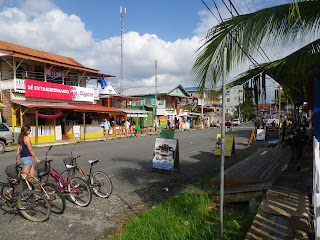
                                            Mainstreet Bocas del Toro

We are looking forward to the snorkeling at Bocas.  We lived on the Atlantic coast of Panama and enjoyed fantastic snorkeling, but now the invasive lionfish has changed the reef environment.

Life should be an adventure.  We will not always be able to do such things, The time is now!   


Thursday, September 16, 2021

Covid complications

 Not quite yet home from our trip to Switzerland.  I woke up about 3 am today due to jet lag and have been thinking about travel advice. Authorities are collecting reams of data and continually changing regulatory guidance to cope with this pandemic.  What I have observed:  1) You should be vaccinated, but it will not be enough.  Current Covid tests will be required.  2) The test costs can be anywhere from free to about $200. Test center sites can be temporary and may not be well-marked or advertised.  Some sites demand cash.  3) Do not travel without a cell phone with reliable and quick download capacity. (I have upgraded mine; we barely got by.). 4) The forms you will need to fill out are ONLY online. Download form, fill out extensive questions, verify statements, upload data (passport, boarding pass, cell number, your destination address, etc.) Then submit and await verification that it was received.  Requirements will vary by country.

For Covid, authorities not only want to identify you, and verify your status, but also be able to track you in case of an outbreak. We had to download a form, fill it out, submit, get a return certificate, and then.... no one ever asked for the certificate.  Leaving on our trip, vaccination by itself was stated to be adequate to enter Switzerland.  A few days later that was upgraded to a Covid test.  While staying at a hotel in Zurich, they upgraded requirements to where you needed to show current vaccination to be allowed in their restaurant. More people started eating at their outdoor patio.

An airline agent told us that she has had multiple people break down crying from the stress of compliance. Imagine going through a long line, then discovering that you cannot provide the required information before your flight leaves. (We shared that feeling of desperation.)  Add in flight delays and cancellations (both of which we experienced).  Is your test good for 48 hours, 72 hours, or three calendar days.... the answers vary.  Is the rapid test good enough, or do you require the more complicated PCR test.... we were given uncertain answers. If you get a “breakthrough” infection, expect a hotel room quarantine.

But Switzerland was great!


Sunday, September 12, 2021

Back to the United States

 Dawn and I realize that we are both Europhiles.  Does that make us less patriotic?  I don’t think so.... having served with the US military for almost fifty years.  But, we have seen enough to realize that there are many satisfying aspects to European life, and the US is no longer the “shining city on a hill”, or the land of freedom and individual liberty as it has been portrayed.

Another Covid test was required.to re-enter the US.  Upon arrival at the Zurich hauptbahnhof, we came upon a temporary testing station that had been set up, and the line was short.  So we signed up.  Again, sign-up required a download on our cell phone plus payment in cash, Swiss Francs.  But we got it done with negative readings!  And for less than half what we paid in Chicago. Here in Switzerland the trains run on time; in fact, everything works like clockwork. It makes our stay in Washington, DC, seem third world by comparison.

Bikes we rented at the SBB train luggage office.  It was Sunday and the other bike sources were closed. Look at how tranquil the water is.

Getting near the end of boating season, but this beautiful runabout was still on the water.

Having got the testing out of the way, we again rented E-bikes and pedaled to Rapperswil at the far end of Zürichsee, about 40 km. away. Receiving these bikes in the center of Zurich, we initially had to pedal through city traffic.  In Europe, bicycle rules are very strict; a 100 CHF fine for riding on the sidewalks.  When we previously had rented bicycles in Copenhagen, we were given a short course on rules for riding bikes in city traffic, so we had some knowledge.  About the same as driving a car..... with all the traffic signs in a foreign language.

What a beautiful church scene!  A cemetery with many flowers was next door.  Passing out of the city, we rode through a park promenade and then followed the shore except for side trips.

We rode the east shore of Lake Zurich and made a few stops along the way.  These statues look out across the lake at Meilen. We had very poor guidance on finding the optimum bike route.  With a more detailed map we could have done better.

 Our entire route this time was confined to bike lanes painted on the streets.  In places the streets are too narrow for bike lanes, and you have to trust the alertness of passing drivers. After a food stop (simple groceries enjoyed at a park bench overlooking the harbor) and exploring the local schloss (minor castle), we put our bikes on the train and relaxed going back to Zurich.

Rapperswil harbor with the schloss in the background.  We could have taken a boat back to Zurich but it would have been much slower.

The castle at Rapperswil.  It is a prominent landmark and had many visitors (perhaps because it was Sunday?)
 

Renting these bikes was not as easy as you might imagine.  We went to the TI (tourist information) and they referred us to the train luggage office.  The luggage clerk on duty said we needed to make a reservation online. It was late in the day, and we found the website confusing and unworkable. Next morning we went back to the TI for help. They also found the website to be unworkable. Thus, back to the train luggage office where a nice woman completed the paperwork and finally gave us E-bikes.

Will we come back here?  Dawn rates this as the best trip we have ever taken.  Nice, but I can fondly remember other enjoyable circumstances.  Comparisons can be like apples and oranges.  Our intentions are to return, but life has a way of introducing new circumstances to alter choices.

Hotel Adler where we stayed in Zurich.  This is only about four blocks from the hauptbahnhof.  Located on Rosengasse; "gasse" being another name for alley.  Very nice people.  They had held our initial room deposit for almost 18 months due to the trip delay.

A percussion band playing outside our hotel in the small open square.  We also got live music from the bar across the street "Splendid Bar".


Conclusions: 1) Weather was warmer than expected; 72-79 degrees rather than 65-72 as forecast. Packed too much warm clothing.  2) Almost everything can be paid for with a credit card, but we were fortunate to have the 100 CHF for our COVID tests.  3) Worthwhile to understand the train system; it is very convenient when fully understood.  Planning for a destination, you can not only know the timetable, but the train composition. Certain cars are arranged for children play areas, handicapped, dining, bicycle transport, scenic vista, and class 1 versus class 2.  Beforehand, you can know where to stand on the platform to enter each car type and how crowded it is likely to be.  Train stops may be for two minutes or less, so decisions need to be quick.

Saturday, September 11, 2021

Lucerne. (Luzern)

 Lucerne is an extremely scenic city.  You are walking on a central city street; you look up, and there is a rugged mountain peak, or a series of lush hillsides, or boats out on the wide waters of a lake.  It is listed as the #1 summer tourist destination in Switzerland.  We are staying at Hotel Central, a boutique hotel (our favorite type of accommodation) only two blocks from the bahnhof, which makes everything convenient. Trains, boats, and busses are easy to reach, yet we are able to keep our hotel room window open and the evening atmosphere is quiet.

Central Luzern; the bridge in the foreground is named Rathaussteg.  The prominent building is the Jesuitenkirche.

A typical scene looking out on Lake Lucerne surrounded by mountains.
 

Our first day trip was to Rigi Kulm, a mountain top with hotel to the east of Luzern, where Dawn’s sister worked for a summer in her college days.  We had been there before, but the hotel had changed in the intervening years. The excursion required a boat trip across the lake to Vitznau and a cog rail train to the top. Great views at a 6000’ altitude with no clouds to obscure it.

View from the top of Rigi Kulm.  Not a tall mountain; there are cows grazing in this area.

Photo taken from the cog rail train just above Vitznau.  Notice how placid the lake is; not sailing weather.

Vitznau promenade with hotel & marina.  The sign in front of the hotel advertised rooms at 1195 CHF per night, about $1300.

A clear view of Pilatus.  To get to the top, we took a steep cog railway up what you see as the left-hand side of the mountain. then a series of three cable car systems descends on the right-hand side of the mountain.

Next was a day trip to Mount Pilatus, to the south of Luzern and somewhat taller at 7000 feet.  We first took a boat to Alpnachstad, then boarded a very steep cog railway with the train seats stair-stepped inside the actual cars which are ascending at a 40-degree angle.  Descending required a series of gondolas: very steep, moderately steep, and then a more normal incline.  We skipped the lower one and walked the last few miles, stopping to enjoy the scenery as we walked.  These mountains seem tall, but we are still at an altitude more than 500 feet lower than our home in Colorado.

There is a trail, if you choose to hike up the entire distance to the top.  Look closely (or expand the photo) and you can see the trail and tiny figures ascending.

               Gondola descending in the first stage from the top of Pilatus.

Gondola on the lower slopes of Pilatus.  Instead of taking this convenience, we elected to hike to the bottom.  Just when we reached the bottom, a rain cloud came through, but we had each packed an umbrella in our back packs and kept dry.

Still hiking but at a lower level.  Our hotel was located about where you see the left end of the lake.  We took a city bus the last few miles to the hotel.

For a change, today we rented e-bikes to ride in the countryside.  Since we are staying in the center of Lucerne, we rented our e-bikes from the SBB train service at the bahnhof and took the bikes on the train to the outlying smaller town of Zug.  Zug is on the shores of a lake, Zugersee. Our bike path brought us to Rotkreuz before we elected to turn back. The weather continues mild; people were boating and swimming along the shore. Pedaling our bikes takes us right through parks, fields, and neighborhoods on a beautiful Fall Day.

Famous sculpture hewn into the native stone just a few blocks from central Luzern.  It commemorates the Swiss Guards killed in the French Revolution. Note the broken spear in the side of this dying lion.

We were allowed a late checkout at our hotel on our final day in Luzern and took one last lake cruise to a small village with a cable car system linking it to a luxury resort on a high plateau, Burgenstock, overlooking the entire region. They had condominiums for sale, but I am sure that they are way above our pay grade.  Dawn wants to return and live near Luzern for an extended period.  You need a visa to stay more than three months.

View from luxury hotel atop a plateau a thousand feet above Lake Lucerne.  Rigi Kulm is in the background.

We are loving the Swiss Travel Passes we bought.  Very convenient, providing free or discounted costs at many points, and allowing freedom in planning.  If we do this e-bike rental again, we will take the train to one town and then get picked up at a different town after biking between them.  There is a bike trail that crosses Switzerland from Lausanne to Zurich in 13 stages.  It is named the Herzroute.

Thursday, September 09, 2021

Lausanne and Lake Geneva

 We are gaining confidence in our understanding of the Swiss public transportation system.  Arriving in Lausanne by train (now French-speaking announcements), we put our luggage in a locker and quickly transferred to the Metro to visit the old part of town. After walking the old city (not amazing) we took the Metro to the lakefront (section called "d'Ouchy), for a walk on the promenade and a sumptuous dinner. A goat cheese salad, a half liter of beer, and sorbet for me. Then, after retrieving our luggage, we flagged a taxi to take us to our B&B in a residential neighborhood.

Dinner at the Lausanne harbor.  Those little pancake-looking things are full of goat cheese; delicious (this is the French part of Switzerland.).  Plus a half liter of good beer.

Side paddle wheel boat built in 1910.  We cruised Lake Geneva to Montreux on this.  The Swiss Travel Pass covers all these lake transports.

Our taxi driver let us off where he insisted our B&B was located, but he was off by 1 1/2 blocks.  Given the density of multi-family dwellings and the convoluted streets, we might never have found the correct address except that a nice gentleman came out to empty trash, and we solicited his help.  We called our hostess; he provided our location; and our B&B  hostess drove to our location to guide us to her home.

We quickly learned the local bus schedule (every ten minutes) and had no further needs for a taxi.

Lake Geneva is very large, almost 50 miles long, with the southern shore part of France and the north a French-speaking part of Switzerland.  Lausanne is central to the north shore.  While here, we took two day trips.  First we took a boat trip to Montreux.  Our vessel was a 250’ long, side paddle wheeler built in 1910 but maintained in beautiful condition; a scenic way to see the entire shore.

The north shore of Lake Geneva covered in vineyards.  Note that there is very little wind.  We saw many sailboats in Switzerland, but the wind did not blow during the 16 days we were there.

Walking the Montreux promenade; it is miles long with constant flowers and artwork and statuary. This is mainly a resort town and very pretty.  The climate here is surprisingly mild with few freezing days.

The flowers were in full bloom; no sign that the season was ending.

This is a favorite area for local tourism, being near at hand and with an almost Mediterranean climate.  The hillsides show many villas surrounded by extensive vineyards.  Reaching Montreux, a high-end resort town, we enjoyed walking the miles-long promenade with its endless flowers and artist’s sculptures. We followed that with a tasty meal at a Middle-Eastern restaurant.  Then we hopped the train back to Lausanne.

Another yummy dinner with beer.  Fine dining is fairly expensive, but we were on vacation!  The weather was such that our meals were invariably taken out-of-doors.

We had planned to cross the lake to Evian (where Evian water comes from) on the French shore the following day, but when we arrived at the pier, we were informed that, as outsiders, a new Covid test would be required for us to cross the lake.  We quickly changed our destination to Nyon, a smaller town in the SW direction of Geneva, and took the train instead.  It proved to be a pleasant day.  The town is smaller but scenic.  The train station is at the high side of the town with cobblestone streets and shops cascading down a steep hill to the marina.

Nyon waterfront and marina.  The marina approach from town is rather steep; we found an elevator at a parking lot to help with the differing heights.

         A well-maintained town castle in Nyon: now a public building.

                                           Gate from the castle to its courtyard.

 I had a meal of calamari with my usual half liter of beer at a lakeside restaurant.  We shopped our way back up the hill, buying only some sunscreen (new tech and unavailable in the US), and took the train back to Lausanne.

            I couldn't leave you without showing the calamari (plus rice and vegetables) dinner and thirst-quenching beer.

In Lausanne, we transferred from train to Metro, had dessert at the harbor, then the Metro to Flon station where we transfer to a bus to Bugnon, near our B&B. Not as much hassle as you would imagine.  All these forms of transportation are interconnected by distance and schedule so that wait times are short.


New Travel Dreams

 Where next should our travels take us?  We have already visited seventy-plus countries and lived overseas for eight years.  There are few n...