Sunday, April 30, 2023

Leaving Sevilla

 We have been riding trains (7) which run at or close to full capacity.  Crowds of passengers on the loading platforms, people on the train with hacking coughing, if we haven’t been exposed to Covid, or worse, I will be surprised.  Also, dense crowds milling in the narrow alleys, “calle” of the old city neighborhoods we have visited.  Here in Sevilla, temperatures have reached the mid-90s the past few days. Amazing to consider how many man-years these historic structures required for construction with the crude equipment they had.  But slave labor is cheap.

Roman aquaduct at Segovia.  No mortar was used between the blocks of stone, but they were carefully shaped; how did they do it!

On our way to Tarifa, we stopped at Jerez de la Frontera.  The city looked rather drab at first look, but then we found the central old town area. Of course, there was a celebration going on.  We love those pedestrian-only streets.  It was a nice lunch stop.

A rental car “coche de aquiler” was used for the next leg of our trip with our immediate destination being Tarifa on the south coast.  Tarifa, located adjacent to the strait of Gibraltar, has an ancient history itself.  The narrow, crooked lanes of the fortress interior are now shops and restaurants for the tourists here.  Very enjoyable that the crowds found in larger cities are not present here. Also, there is a wide sand beach which stretches for miles; I counted almost fifty kite surfers on their hydrofoil boards playing in the ocean off that beach.

Tarifa has a beach that is miles long, what you see is only a moderate section.

Today we go to Tangier, Morocco, for a day tour, taking the ferry between the two continents, Europe and Africa. We have a guide and a van for a tour of the finer points of Tangier and a village to the west.  He loves his country, apparently ruled by a king who is making improvements for the people.  But still, women are far from being equal in this world and the economic disparity between the favored and the poor is tremendous.  In rural areas, formal education ends at primary school, age 13. For the favored, university is free.  We saw the huge estates of the wealthy; hiring servants here is very economical.  We visited a souk where we were encouraged to buy any of a world of items, but none would fit in our luggage.  We had a traditional Moroccan meal; not very memorable, hacking bits of lamb off a large bone.

Morocco as seen from Tarifa, Spain.  You can see a ship traversing the strait.  Further to the right of this photo, the buildings of coastal towns were also visible.


Coastal resort in Morocco.  Magnificent estates for the rich, not so much for everyone else.

Back in Spain and driving onward, we stopped for lunch in Rhonda, a town in the mountains built on the edge of a cliff.  That cliff has been a godsend for their tourism; otherwise, the town is fairly typical. 

Ronda showing its cliff-edge location.  A tourist magnet in a remote mountain location. 

Turning in our rental car at Granada, we were ready for our reservation to visit the palace at the Alhambra.  At 1pm, we were part of a large crowd herded through the many rooms.  The details are amazing in their complexity, but the crowds are distracting. I took only a limited number of photos because many scenes were dominated by the crowds of people. The surrounding gardens were somewhat better.

The main Alhambra complex from a distance.  They say the Moorish style was to have simple exterior lines and ornate interior features.

Looking south to the Sierra Nevada mountains south of Granada.  They have ski resorts there. 

The following day was free, no pre-planned activities. We took a taxi to the high point in the city with great views, then we walked the narrow back streets downhill on our way back to our hotel. At an Arabic “souk” of closely spaced small shops, Dawn bought a skirt. Later that day, we headed out walking in a new direction until all our surroundings were unfamiliar to us; then we consulted GPS and plotted a route back to the hotel, stopping for ice cream along the way.  The neighborhoods are attractive with their park-like plazas, many small specialty stores, and restaurants/ tapa bars.

Now we are in Bordeaux, France.

Thursday, April 13, 2023

Las Palmas arrival, Canary Islands and on to Madrid

 After 15 hours sitting on our flights, we arrived at Las Palmas in the Canary Islands. An overnight flight in an economy seat (we paid for Premium Economy but that just meant that our seats were farther forward) on a very crowded aircraft, followed by a night in Madrid (lying awake with jet lag) and an early onward flight to Las Palmas, left us very tired, but our hotel in Las Palmas is wonderful. Madrid airport is huge, but I think we have the layout understood; important because we will be passing through it two more times (with a 65-minute flight transfer) later in our trip.

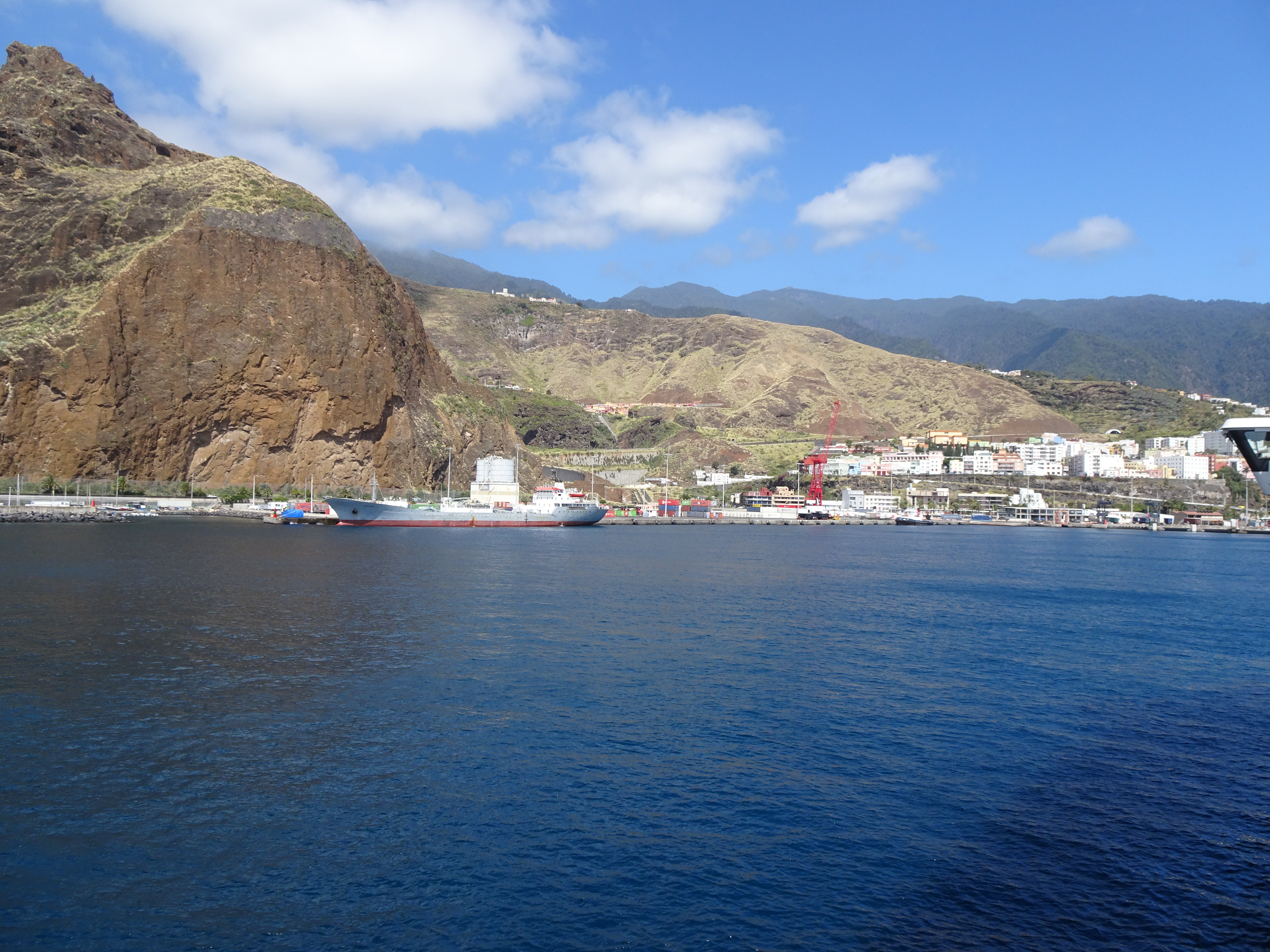
Steep and dry volcanic, the Canary Islands.  The temperatures were mild (70's) during our entire visit.

I went on two e-bike rides in the Canary Islands.  Does this look like fun?  Great exercise as it included two climbs' of 1000 vertical feet, but not that scenic. 

This was the ultimate goal of an e-bike ride.  The remains of a caldera, not very amazing.  One of our group crashed his bike in the loose volcanic gravel, nasty scrapes.

The beach at Las Palmas stretches for a mile.  Very relaxing for a long walk with a stop for ice cream or sorbet along the way.


Beautiful but rugged.  When first climbed in modern times, primitive artifacts were found at the peak from climbers long ago.

Our hotel LUMM is positioned close to the beach, bus depot, and cruise landing which makes it ideal.  The airport is about 12 miles away. We have discovered amazingly great shopping malls here. I believe that this is due to the large volume of tourists combined with a much lower VAT tax than European alternatives.  Dawn and I are not much interested in museums; shopping malls by contrast record the current culture of a region.

The inner harbor at one of the Canary Islands.  After strolling the waterfront, we found a nice shopping mall on a pedestrian-only street.  Ale-Hop was our favorite store offering everyday items you didn't realize that you needed.

Our weeklong cruise on the World Traveller was wonderful, with less than 150 guests, there were no crowds, meals were served in one sitting, and we met several interesting fellow voyagers.  The Canary Islands were worthwhile for one pass; but not interesting enough for a return trip.  A lot of dry volcanic vistas, roads that were up and down, and habitations without much character.  But now we know what the Canary Islands are like.

Hydrofoil windsurfing.  Note that his board is completely out of the water.  It helps that the wind is strong here.

The Madrid Marathon took place while we were there and went right through our area.

Flying to Madrid, we were quickly immersed in the center of a metropolitan area of almost seven million persons.  We are in a small hotel which provides excellent service and is right across the street from the Four Seasons hotel, which makes it easy to provide directions to taxi drivers.  The taxis here are reasonably priced and well regulated, confidence inspiring.

Today was our first train ride here.  We explored Madrid Atocha train station yesterday to make sure we understood the layout of the immense facility.  The orientation helped, and now we understand the system much better; good, because we have train trips for the next two days.

Train or airport, terminals double as shopping malls and transportation centers. Thus, they can be quite complex.  Trains have the advantage that most distances in Europe are modest, and a train terminal can be mostly underground, allowing it to be located near the center of a city.  Not sure how they do it, but many trains in Spain run fully occupied, thus, you need a seat reservation to be allowed to board.

Toledo, Spain.  The cathedral here is the most beautiful in the country.

From Madrid, we took day trips to Toledo and Segovia. We then took a train to Sevilla, and from here in Sevilla, we will take a day trip to Cordoba. Then we switch to a rental car.

View from a park in Madrid; palace on the left and cathedral on the right.


Monday, April 10, 2023

The Indian Ocean & South Africa

 We recently put down a deposit on a cruise from the Seychelles to Sri Lanka.  It will truly be a unique 'bucket list' experience.  When you get to Sri Lanka, you are halfway around the world from Colorado.  To get home, you can either fly east or west.

First stop will be Washington, DC, to visit family.  Second leg of the trip goes from DC to Dubai.  A direct flight from the US East coast is about 13 hours.  I hoped to break that up into two segments, but the other choices did not work out.  More stops would make it more interesting, but we don't have time for that with a fixed cruise date, so the 13-hour flight is it.  We have time for three days in Dubai and four days at Mahe Island before the cruise.  Dubai should be an amazing city.

Crossing the equator by air, we will arrive at the town of Victoria, capital of the Seychelles, and explore Mahe Island by rental car; then we embark on a small ship cruise through the Seychelles and Maldives, arriving at Colombo, Sri Lanka, fifteen days later.

Disembarking at Colombo, we spend the next eleven nights on the island nation of Sri Lanka (1/4 the size of Colorado) checking out the central hill country with tea plantations and also the southern beaches.  We have had difficulty getting detailed information on the train system; taxis have been recommended instead.  Then it is time to fly again.  We have decided to head south, instead of east toward Singapore.  We originally were going to do Singapore, Taipei, Tokyo, and San Francisco on our way home, but those are all big cities, not our favorite destinations.

Dawn has become interested in Cape Town; thus, we redirected our trip in that direction. We fly back to Dubai for one night, re-cross the equator, and fly to Cape Town, South Africa.  While there we plan to visit the sights around Cape Town, tour the wine country, and fly to Port Elizabeth and enjoy game drives from a safari lodge. Safari lodges need to be booked well in advance.  We will be there thirteen days total.  Reservations for getting home to Colorado were paused to consider the choices.

How to get home?  The most obvious choice would be a sixteen-hour flight directly to the US East Coast, but 16 hours is so long!  I went to Kayak.com and other travel sites looking for other options.  No luck.  Then I went to our world globe and stretched a string (dental floss) from Cape Town to Denver.  The path shown stretches from southeast Atlantic Ocean to the northeast coast of Brazil, eastern edge of the West Indies, crossing the US coast at the Florida-Georgia border.  Dividing that distance to the US into halves puts us in Brazil.

I discovered that we could fly to Sao Paulo, Brazil, 8 1/2 hours and spend a few days there.  That flight only goes a few times per week.  From there we have choices: Fly to Miami 8 1/2 hours plus 4/1/2 hours to Denver.  Or fly to Panama City, Panama, 7 hours plus 6 hours further to Denver.    The Miami route is an overnight flight, leaving late in the evening, while the Panama City route is a 5 AM departure. Then I found a daytime 10AM flight: 10 hours to Atlanta plus 3 1/2 to Denver.  We choose the daytime route through Atlanta; easier to coordinate with our hotel stay and gets us home sooner.  Besides, Dawn never sleeps even on a nighttime flight.

For a trip like this, it is basically, now or never.  We are fortunate to be healthy enough for planning such a lengthy undertaking.  I picked the cruise; Dawn picked the South Africa destination.  It would be ridiculous to not spend time in Sri Lanka after the long haul to get there.  Eight weeks will be needed; now, can we get someone to pick up our mail while gone?

Total distance traveled will be just over 30,000 miles (not counting local travel); more than a round-the-world flight.  We do not fly economy at our ages. Seven currencies to be used:  US dollar, Emirati Dirham, Seychelles Euro, Maldivian Rufiyaa, Sri Lankan Rupee, South African Rand, and Brazilian Real.  Fortunately, a credit card will cover most of those expenses without requiring currency conversion.

Tuesday, April 04, 2023

Scotland and Sardinia

 Our son called to say that their children will be back from Spain and out of school in late August; would we like to come visit?  Late August in Washington, DC, is hot and humid.  But what if the visit was the start of another longer trip?  Would that make a DC visit more attractive? We have never been to Scotland, although it has been under consideration for a few years.  In early September the main tourist season in Scotland should be ending, and the weather still acceptable.  We have made reservations for when we initially arrive and for the last day before we leave.  In early September, Scotland tourist season is apparently still quite busy.

Once in Europe, what other destination might be attractive?  Something further south?  I looked at cruises, but nothing quite fit. What about Sardinia?  Sort of off the usual tourist route.... but attractive.

Sardinia is a semi-autonomous part of Italy. The main tourists there are other Europeans, many from Italy itself.  Finding flights to and from Sardinia without multiple stops, airline flight changes, hours spent in terminals, and rechecking of luggage was difficult.  If you are rechecking luggage, that means you are going through security all over again. But I have practice at this and found options: KLM Dutch going there via Amsterdam and Swissair returning via Zurich and London.  These flights are scheduled only 1-2 days per week.  Sardinia has two main international airports.  We fly into the south end of the island, Cagliari, and fly out from the north end of the island at Olbia (necessary in order to get the needed flights).  So, it will happen, two weeks in Scotland and twelve days in Sardinia.

Now to practice some Italian on Duolingo; surprising how different it is from Spanish.

Frustration! Our flight from Glasgow to Amsterdam was cancelled which means we miss the connection to a direct flight from AMS to Cagliari.  We have had to reschedule to an earlier day and a book a flight with an additional stop in Rome.  This also affects hotel reservations and rental car reservations.... but I got it done.


Post script:    Then our KLM flight was delayed, then cancelled again.  Instead of arriving in Sardinia at 18:30 on Saturday, we arrived at midnight on Sunday.  Because we were late, our vehicle rental was cancelled; also, our luggage was lost, and the weather was unusually warm with a significant haze.  Our worst trip ever.


Sunday, March 12, 2023

Spain and beyond.

 We have a six-week trip to Europe almost planned; just a couple minor accommodations and some car rentals left to do.  We start by flying to the Canary Islands.  We have a one-week cruise there and are arriving a few days early. Then we fly back to Madrid and spend two weeks in southern Spain with a day trip to Tangier, Morrocco and tickets to tour the Alhambra.  While in Europe, we might as well take advantage of it, and Dawn wouldn't mind spending the entire summer there.

We have been to France on previous trips but have missed the southwest part of the country.  Thus, we are flying to Bordeaux and driving (130 miles) to Salat-la-Caneda in the Dordogne River valley for a scenic stay. Then we fly to Manchester, England and rent a car (137 miles) to spend a week in the Lake District of northern England.  From there we fly back to Washington, DC, with a brief flight change in Iceland.  

In DC, we want to see our grandchildren often as they are growing and changing fast. Then it is back to Colorado.  It should be a great trip.  A little late in getting reservations; amazing how many flights and accommodations where we got the last room or last two seats.  But I think they were being honest; I could see that in most locations, at least half of the hotels were already fully booked.  

How many more years will we be able to do this?  On a recent exam visit to my physician, he told me I am exceptionally healthy for my age.  That actually bothered me; I would prefer to think that most people of my age are still healthy.  Exceptions usually revert back to the mean before too long.  We do try to live a healthy lifestyle.

The longest trip we have planned thus far, and it should be great.  

12 accommodations

9 flights, 5 airlines

7 train rides

3 car rentals

2 ferries'

1 small cruise ship,

stops in 6 countries

My concerns:  1) I need to familiarize myself with the Spanish train system.  We hope to use the train for day visits to Toledo, Segovia, and Cordoba.  This system is different than the Swiss trains. 2) Wish our French was better.  We lived in Panama for 3 years and Germany for 3 years and have some familiarity there, but we have never had much French exposure and are traveling to a part of France that doesn't see that many English-speaking tourists.  3) Driving on the left side of the road, seated on the right, manual transmission on left, in the Lake District of England could be challenging.  We will never forget driving on backroads in the low mountains of Ireland.  No road shoulders to pull off on, overgrown with shrubbery, extremely narrow winding roads, and relatively high speeds.  We both retired to the bar as soon as we got back to our hotel for a tall drink.  But, in all our travels, we have never had even a scratch on one of our rentals.

It will be part of the challenge.


Sunday, October 23, 2022

In time for Octoberfest

 Imagine, flying at 38,000 feet at over 600 mph to cover 5000+ miles in half a day!  What an amazing world!  Now we are eating dinner in a fine restaurant in Zurich, Switzerland, in the altstadt. Tomorrow, we take a train to Strasbourg, France.  We have been staying in an AirBnB which requires us to buy our breakfast makings at a local grocery, but that is just a part of immersion in the local lifestyle.  Everything here is in Deutsch, but we have some knowledge of terms, Google translate is helpful, and the Swiss people usually are helpful.

Swans on the river at Zurich promenade park


This is classic Strasbourg, beautiful half-timbered buildings on the river front.

Beautiful, but this is not the main attraction in Strasbourg.  A much larger cathedral (150+ yards tall) gets more attention.

When we arrived in Strasbourg, we dragged our suitcases from the train station (bahnhof) to our accommodation because most of the area has pedestrian-only streets (fussganger), faster on foot than by vehicle.  When we arrived at the street entrance to our apartment, our landlord had been watching from an upper story window and called out to us by name.  They had stocked our refrigerator with drinks and snacks.  Very nice people.

Dawn has been to Strasbourg previously, but this is my first time.  We are surprised at the large number of tourists; is this a French holiday?  Nevertheless, the city is very scenic with an incredible cathedral, as tall as Notre Dame.  We are again staying at an AirBnB: beautiful, spacious, perfect location, and very welcoming.  Again, one of our first stops was a natural grocery store to get breakfast supplies, including lactose free items.  French is a language we know very little, but English is becoming the international language, making things easier.  Our train trip here (switching from Swiss to French at Basel) went perfectly.

This is the main cathedral in Strasbourg, a major tourist attraction.  Our Airbnb was just one block away.

It is easy to get lost in Strasburg, the streets are laid out around a winding river and its many bridges, thus the streets also have a curving pattern.  Strasburg is a significant city and was even a more major meeting place historically.  At some times in the past, it was part of Germany, thus, there is a German influence in some of the more recent neighborhoods.  The preserved architecture, half-timbered buildings, is a significant reason to visit the city.  Our accommodation is probably 300 years old.  The ceiling is about 6 1/2 feet high, and part of the floor is about 4 inches lower that the other section.


We walked the old town and used a narrow-gauged, rubber-wheeled urban 'train" to see even more of the area.  We both got Covid, which we must have picked up in Zurich or on the train.  For me, it could easily have been confused with a cold (mainly sinus congestion), but Dawn's symptoms lingered a bit longer, so we bought self-tests at the local pharmacy which confirmed our suspicion.  Both of us had previously been fully vaccinated and Dawn had had a previous (and more serious) bout with Covid despite the precautions.  Evidently Covid has become like the common cold: a condition we will just have to learn to live with.  

Being the very end of September, we experienced some cooler and drizzly days.  There are many small wineries in villages of the area.  Due to lost time from Covid, we will have to take that tour at another visit.  Our time was up in Strasbourg and our stay in nearby Colmar was only three days.


Thursday, October 20, 2022

A Fall trip to Switzerland

 Our visit to St. Gallen became a fateful experience.  We arrived on a Sunday afternoon and found our Airbnb apartment where we expected to stay for the next six days.  From here we could easily take daytrips by train the visit the Bodensee to the north (on the border with Germany) and visit the scenic mountains to the south at Appenzell and Wasserauen.  We then did food shopping (Sunday and only a grocery at the bahnhof was open) and went for a walk to explore the city.  A cog train ride, Muhleggbahn, takes you to a ridge overlooking the city.  At the top is a scenic walking path, "wanderweg", with a series of three ponds and recreation facilities along the trail, Drei Weieren recreation area. 

A couple days later, Wasserauen was our destination by train (end of the line) and then by a cable car to Ebenalp, at 5380 feet altitude, the northern most peak of the Appenzeller Alps, on a high ridge.  A lodge at Ebenalp serves meals and snacks or even an overnight stay.  Several trails fan out for hiking to mountain crest locations.  There is also a steep open meadow with windsocks which is popular for launching by paragliders.  Great views of the surrounding mountains and valleys.

Approaching Ebenalp.  At the very top center of this photo, if you look closely, you will see a building; that is where the cable car takes you and where the paragliders launch from.

This is a more close-up view of Ebenalp.

And here is a paraglider launching from Ebenalp.  This is not a ski slope, as vertical cliffs surround the area.

To get to Wasserauen we needed to change trains at Appenzell.  The town was full of visitors and also cows.  Not sure what the purpose was of this gathering, but the parking lot across from the Appenzell brewery was full of cows in secured close order.  The next day, the same area held a gathering of goats.  A scenic river runs through the town, and we noticed signs marking the routes for several bike trails.  The AB bahnhof there had e-bikes for rent; thus, we made reservations for the following day.

The town of Appenzell, perhaps best known for its scenery and its brewery.

We returned to Appenzell the following day and picked up our rented e-bikes.  We took a pleasant, mainly paved trail and rode our bikes back to Wasserauen and beyond.  At the head of this scenic valley, it becomes a narrow and steep gorge leading upward to a lake and, above that, a naked rock peak with banks of snow in areas more sheltered in the shadows of cliffs.  End of the trail for our bikes. 


The cutest little church in the most scenic location in the valley of Wasserauen.

The green fields look like a carpet covering the entire valley, no crops but pastures for cows, sheep, and goats.

Time for one more photograph before we head back to Appenzell.

We headed back by a different path rising above the valley, diverted into a new area to explore, and then found our way back to Appenzell for refreshments and a potty stop.  Heading west out of Appenzell to follow a new route, Dawn took a serious fall on the cobblestone paving and, effectively, our entire vacation was over.

After the arrival of an emergency ambulance, she spent the next nine nights in the St. Gallen Kantonsspital where she was stabilized, and pain control was achieved (after four days).  The initial question was whether she would need surgery there in Switzerland or could she be moved back to the US.  Upon arrival at the hospital, I was asked to provide an immediate 12,000 Swiss franc deposit.  My job was to take care of the logistics of her hospitalization and start planning for our return to the United States if possible.  The medical care there was excellent.

Once I could see that some measure of pain control and stabilization was achieved, I was able to contact Delta Airlines (our most convenient connection) by telephone and arrange wheelchair service and first-class seating for our flights home.  Due to the hip fracture, Dawn could not walk.  Due to her severe elbow fracture (impacted, displaced, comminuted) and resulting cast, she could not wear normal shirts or sweaters.  We could only wrap garments around her.  Zurich airport transfer went well.  Going through security at JFK airport was a nightmare; they expected her to walk and ignored her when she couldn't.

However, part of that time we were simply waiting for her condition to improve with nothing I could do to speed it up.  I was able to take a couple of daytrips by train to visit Rorschach, Haiden, and Winterthur.

The central platz in St. Gallen.  If I panned to the right, there is a large cathedral complex with several buildings.  The interior of the cathedral is very beautiful, but after you have seen a number of such cathedrals, they start to look alike.

Fall was in full force while we stayed in St. Gallen.  I walked through this area every day walking between my hotel (after moving from our Airbnb) and Dawn's hospital room.  The Talhof festival began the day before we left the area.

Rorschach is on the shores of Bodensee, alternately called Lake Constance, which is a large lake separating Switzerland from Germany.  Haiden is visited using a cog train; it is a small town at higher altitude from which, on a clear day, you have a vista of almost the entire Bodensee and into Germany.  Winterthur is a larger city to the west which has a large fussganger district (pedestrian only) with many small, specialized shops and interesting displays.  Nearby are also pleasant green park areas.


My visit to Haiden was a bust as far as seeing distant views.  The town was socked-in, immersed in a cloud bank.


Our trip back to the States was long and tiring.  We had arranged a van with wheelchair to get us to Zurich, and we were met with wheelchair service at Zurich, New York, and Denver airports.  Now Dawn needs surgery, convalescence, and then we head for Washington, DC to see our grandchildren at Christmas. 

Thursday, September 29, 2022

Basel, where French, Swiss, and German come together

From Strasbourg a train ride brought us to Colmar, France, another Alsatian wine country town.  Again, very scenic with an extensive old town district.  Dawn & I had both caught “colds” in Strasbourg; however, when Dawn’s symptoms were prolonged, we got Covid tests, and we both tested positive.  Thus, we backed off on a wine village trip and have been preparing our meals at the apartment.  I purchased decongestant meds for Dawn which greatly improved her outlook.  

A winding river courses through Colmar.  These building are hundreds of years old.  An altstadt Colmar scene.  Colmar is similar to Strasbourg except smaller and with a less magnificent cathedral.  Apparently, in the past, the church held enormous power.  Those cathedrals are by far the most elaborate and large buildings in most of these old cities.


This ferry boat crossing the Rhine River is powered entirely by the river current.  The boat is attached to a cable which crosses the river.  By turning the rudder one way the boat is pushed to port; turning the rudder the other way causes the boat to tack to starboard (like a sailboat).

Now we are in Basel.  I had made a hotel reservation in Basel near the bahnhof, thinking that it would be very convenient for our travels.  Turns out there are multiple bahnhofs: a Swiss SBB Hauptbahnhof, a French gare (French for bahnhof), and a German DB bahnhof across the Rhine River.  Our hotel is near to the German bahnhof, not convenient for our train travels.  But we are very much enjoying the hotel; they made a special effort to accommodate my lactose intolerance; and we have learned of tram connections between all the bahnhofs and other attractions.  The trams run about every ten minutes, so there is very little wait.  The hotel room comes with a "city card" which allows free transportation on all local public transportation.  Upon leaving Basel we purchased Swiss Travel Passes which allow free travel throughout the entire country of Switzerland as well as free entrance to many museums and reduced price for other attractions.

Market plaza in Central Basel.


The Rhine River was a short distance down the hill from our hotel and has comfortable and scenic walking paths.  We also took an interesting ferry ride across the river.  The ferry boat is attached to an overhead cable and is powered by the river's considerable current.  Walking along the riverbanks ensures that you will not be facing hills to climb. At sunset, we found an excellent restaurant for one of our best meals; not cheap, but money well spent.


Yummy dinner at an Italian restaurant on a back street near the Rhine.

While at Basel we needed to decide what our next stop would be.  It was now October.  The more mountainous parts of Switzerland were starting to get colder than we had packed clothing for and with a chance of snow.  For this entire trip, we had brought only carry-on luggage because we wanted to avoid the delay and possible loss of suitcases.  We chose St. Gallen, northeastern Switzerland, as our next destination and were able to reserve an apartment for the next six days.  From that location on short day trips, we could visit the Bodensee to the north and scenic mountains to the south using our Swiss Passes.  Germany, Austria, and Liechtenstein are nearby. 


Sunday, August 07, 2022

A Lifetime Travel Partner

                    1970 at Carmel, California, with my girlfriend, Dawn
 

Today, May 27, 2024, is the 53rd wedding anniversary for Dawn and me.  She is my partner in our lifetime adventure of challenges and travel.  Through respect and love, together we to make a good team.  Fall 1969, before I actually met Dawn, I was studying at our UC college library when I met her roommate, Kathy.  Kathy and I recognized that we lived in nearby apartments in the same apartment building, and we sat down and started to introduce ourselves (much better than studying).  Kathy was a California native from Marin County.  I mentioned that I was a newcomer to the State after service in the Pacific with the US Navy.  Kathy said, "You should meet my roommate, Dawn, she also enjoys visiting new places."  Little did I know then how prophetic that would be.

Later that Fall, in the political chaos of the Vietnam War, riots were taking place on the UC Santa Barbara campus (anti-war, anti-establishment) at that time. Watching from the rooftop deck of our apartment building as a crowd of rioters clashed with hundreds of police in the streets below, our fellow apartment dwellers, mainly students, were sympathetic to the “students” being abused by the “pigs”. A significant portion of the rioters were lowlife hoods who had driven up from LA to create trouble. On the roof deck I noted one girl, a tall blonde, who was arguing in support of the police. She pointed out the gross vandalism and violence of the rioters and that the police were only restoring order. (The riots had been going on for several days and would continue until 400 National Guard arrived and took charge with fixed bayonets, a curfew, ID checks, and roadblocks.)

I took the side of this cute blonde in her argument against her student opposition. Having returned directly from Vietnam to this “Ivory Tower” existence (looking out over the Pacific Ocean), I had no sympathy for their misdirected protests. We left the rooftop that evening without speaking further and had no contact until the end-of-quarter break, but I did not forget this girl. To have the courage to defy the emotions of a crowd, this girl had to be confident in who she was and what she stood for. Admirable qualities not commonly encountered at that age.

 During the Christmas quarter break, most students went home, but my home was in Nebraska, too far away, and Dawn was committed to a job at a local medical clinic. Using a lame opening, I first asked her out, and we started to get to know each other. Dawn grew up with a mother who gave her little support; however, her father was a quiet, steadying influence. He had served in WWII, crossing Utah beach on D-Day, and participated in the advance across Europe into Germany until the end of the war and occupation. He did not discuss his experiences, but simply went on with life. Dawn was the oldest child, often looking after a younger sister, and had learned by necessity to be responsible and independent.

 In contrast, I was the youngest child in a supportive home where I had no shortage of advice from parents plus an older sister and brother. In childhood, I felt I was always being judged by others’ expectations of what I should do. I now enjoyed being entirely on my own. I had applied for California residency and been accepted to the University of California, despite my parents’ disapproval of such a move.

 As we got to know each other, we discovered how much we had in common, despite our different backgrounds. She, from upscale Marin County (north across the Golden Gate bridge), and myself, with family and relatives from the farms of Nebraska. We were both on our own, watching our budgets carefully. We enjoyed simple things like walking on the beach, reading at the library or newsstand, or hiking in the nearby Santa Ynez mountains. I could also rent university-sponsored sailboats at the harbor. We believed in the freedom that accepting individual responsibility brings and that all options were open for our future. I had found a real partner.

Summer 1970, I had an internship with 3M in St. Paul, MN, and Dawn came for a visit. We, along with my apartment mate & his girlfriend (future wife), went camping on the north shore of Lake Superior and canoe camping at BWCA. We were careful to watch for bears when picking blueberries along the shore, but in the middle of the night we had a bear sniffing at the thin nylon walls of our tents. Fortunately, with all four of us yelling, we scared the bear away. Before we both returned to Santa Barbara, I made a detour to Marin County to visit Dawn and meet her family at her parent's home.

 After graduation, I was living in Portland and planned our wedding ceremony there at a small chapel with a pretty tulip garden in a pleasant residential area. Meanwhile, Dawn dealt with her family. Her parents disapproved, thinking she was too young (21) to get married. Her mother did not attend. My parents provided unasked-for, but well-intentioned, advice, and my brother tried to warn Dawn about my “irresponsibility” (perhaps years ago?). Our wedding was the first time Dawn met my family. Brave girl! I was glad that I had warned her about my family's penchant for advice and to trust in what we had planned together.

Our wedding was small; we paid all wedding expenses ourselves, including a post-wedding dinner for everyone at a fancy restaurant overlooking the Willamette River and Mount Hood. Dawn deserved a grander ceremony.  The service was simple, but the commitment was strong.  I was the lucky one with a strong, beautiful, committed partner. My goal was to be the best person that I could be so that I could feel I deserved to be at her side. We wanted no obligations to her family or mine. Our new jobs permitted no honeymoon. We hiked, biked, and sailed our 14’ Lido sailboat (also snow skied). We built our simple apartment furniture with hand tools and saved funds for the future. But we were together at the start of a lifetime adventure.

 A year later we left Portland and spent three months traveling, looking for our next beginning. Now it is 53 years later.  Our adventure has taken us in many directions. We have lived in 16 different towns or cities, 8 states, and 4 countries since then.  We have traveled to more than sixty countries, plus many repeats.  Our children are happy and prospering; we have been fortunate. The goals we shared and pursued have come true and given us great satisfaction.


Thursday, June 30, 2022

Bocas del Toro, Panama

 This has been a unique vacation.  Our first motivation for this destination was the almost thousand dollars in Copa Airline credits we had which expire at the end of June.  Then there was Dawn’s diagnosis of severe idiopathic peripheral neuropathy.  She was told that it was progressive, unknown cause/ treatment, and that she would end up in a walker/wheelchair.  The physician expressed no hope. This trip was viewed as perhaps a last adventure before symptoms worsened.  At the same time, I read about this new luxurious resort at Bocas del Toro in Panama; thus, we booked it.  Let's end this in a big way!

Subsequently, Dawn sought other opinions and was fortunate to find a physician who has provided effective therapy.  High dose B12 injections are reversing symptoms, although treatment may be ongoing indefinitely.  We considered cancelation of our reservation, but ultimately decided you only live once, do it.  Now the focus is on this new resort; what is it like?

Beautiful flowers everywhere.  The head landscaper is from France.  The resort will soon have acres of secret gardens discovered by taking pebble paths through the jungle.  The climate is warm with frequent rain encouraging healthy growth without frequent tending. 

Upon arrival at Bocas del Toro airport, we were met by helpful agent with a Cadillac Escalade which transported us to a private dock where a boat was waiting to take us the 8-10 miles to the island.  Pretty amazing place with a real story behind it.  Originally, this was a hundred-acre mangrove swamp island. To create dry land, they needed to dig channels and ponds to encourage drainage and use the excavated material to build up desired areas.  For all structures they needed to place concrete pilings deep into the soil to find adequate support.  The really difficult part: no heavy equipment could be used; all tasks were mainly done by hand!

Because the island is a converted mangrove swamp, all the walkways are elevated walkways, suitable for wheelchair guests.  The garden paths will not be elevated.

This is what mangroves look like.  The mangroves can extract fresh water from the ocean through their roots.

This is the open-air daytime dining area and bar. A pool is adjacent on the left and a garden to the right.  Other wings of this building include the reception area and fitness rooms.

Beautiful pool which no one ever used!  Perhaps that is because the ocean is at the front door of every villa as well as plunge pools.

The "elephant house" used for evening meals.  It opened at 7pm.  A drink and appetizer were almost mandatory, by the time desert was finished it was 9pm or later.  Excellent food and the menu was changed each night.  It has a fire pit and an underwater light which would attract fish, including sharks and stingrays.

Currently there are 16 overwater villa accommodations (about 700 sq. ft. each with outside covered decks/docks adding 300-400 sq. ft.).  Each of these villas was originally designed and constructed in Bali, Indonesia, then disassembled, shipped to Panama, and reassembled here.  All the major buildings are from Bali using their design and materials. Carved wood beams, thatched roofs, very authentic.  When completed in several years, the resort is currently planning 40 accommodations of several types including tree houses.  The vision for this resort came from one man: Dan Beam, a successful businessman from Michigan.

Panama authorities are allowing the development of about 10% of this island, 9-10 acres.  Everything completed is beautiful with lush tropical growth.  Extensive gardens, ponds, and a freshwater channel are being developed.  We were told there is a wild boar on the island.  Because it is a remote island, water collection and filtration, sewer systems, electrical power, A/C, lighting, internet, worker dormitories, a fleet of shuttle launches, refrigeration, storage.... everything had to be created from scratch.  

The best part is the staff, so sincerely friendly and supportive. Anita, Franco, and Patricio are from Argentina. Nina, Ruby, Yulina and several others are local.  Several are from Costa Rica (about an hour to the border), one from Mexico, one from Texas.  The staff greatly outnumbers the guests.  All staff members are required to be fluent in English, but, while we were there, most of the guests spoke Spanish.

All-inclusive for eating and drinks.  The breakfast/lunch area is separate from the evening restaurant, but one of them is always open from 7am to 11pm.  A variety of kayaks and SUPs are at hand for the asking as well as snorkeling gear.  A beautifully landscaped pool is adjacent to the reception area, and a fitness room with a/c is well equipped.  Excursions to distant attractions cost extra.  Given that Dawn and I had lived in Panama for three years previously and also had visited Bocas del Toro on a previous trip, we didn't find the excursions providing any new experiences for us; thus, we passed.  We have seen plenty of monkeys and sloths, native tribes (Guna Indians), jungle, and remote surfing beaches. We have driven ATVs and E-bikes.

This fish was within 50 feet of our villa.  The snorkeling here was in shallow calm water; thus, simple equipment was adequate for use.  I saw two barracuda, but neither was large.

The colors were vivid in these shallow waters, many creatures flourishing here.  Starfish were common, some were bright orange.

What a pretty cluster of coral growth.  That flower-like organism on the left will close instantaneously if you get too close.

Does that look like a bagpipe?  A beautiful orange color with those nozzles filtering the sea water.

Finger-like cluster.

A little fish hiding out.  I had trouble getting its photo because it would look directly at the camera so all you could see was its eyes and lips.  We had a school of fish that hung out in the shade of our villa behind the pilings.

Another color and shape for these tube-like structures.  The different varieties of sea life were endless (and I have more photos to prove it).

Snorkeling is one of our pleasures.  Here the resort is on a large bay, not the open ocean; thus, there are no large waves or currents to contend with.  The coral formations are smaller, not major reefs.  I was initially disappointed with the snorkel fins we were provided.  They were short, less efficient than the longer fins, but, after using them, they were adequate for the conditions we experienced.  When we expressed our interest in snorkeling, we were moved to villa #1 which is positioned in deeper water and very close to decent coral formations away from the other villas and development.

Our villa with Dawn tying up her kayak.  All the buildings are authentic from Bali with furniture, sculpture, paintings, and intricately carved wood panels.

A calm morning looking from our deck past the kayaks and plunge pool toward the nearby point of mangroves and coral beds concealed nearby.

Dawn out in one of our kayaks.  She really enjoyed it; asked me if I would build her one (now completed).  I want her to try out the boat I am now building first.


We came across two yachts anchored on the other side of our island "Frangipani Island" when we were circumnavigating it.  In the distance, to the west, you can see the cloud-shrouded high country of western Panama near the Costa Rican border.

Our villa was very comfortable, king bed with curtains, walk-in shower, seating area, folding doors with large windows which you could open onto the covered deck.  We had a plunge pool which we never used.  At night there was absolute quiet and looking out from our deck across the water it was absolute black, no lights from the open water or jungle-shrouded shores.

On one of our kayak ventures, we visited an island with a large nesting population of sea birds.  They were swirling in the skies before our visit.  You had to get close to create any additional disturbance.

The weather was variable.  Snorkeling is best on sunny days, midmorning or early afternoon when the sun's rays penetrate deeply to light up the underwater environment.  We use full body suits, rash guards, to protect us from sunburn.  When it was cloudier, we preferred to use our provided kayaks, but even then, we would wear long sleeves and wide-brimmed hats to protect us from the sun.  One day we circumnavigated our hundred-acre island.  We had to follow the contours of every bay since we were unaware of its actual shape and, from a distance, overlapping islands could appear as a continuous shoreline.  We made additional forays to check out other nearby islands.

We flew from Panama City (Albrook) via Air Panama to Bocas.  On the way there, the flight was one hour late.  On the return flight, it was 45 minutes late.  Tocumen International Airport is east of downtown Panama City and Albrook is west of downtown.  The traffic getting through downtown is generally a congested mess.  Our taxi drivers were educated, interesting, and fluent in English which made the commute better.  We stayed overnight at The Santa Maria resort and golf course which is very nice.  We were able to take a long walk in the beautiful surrounding neighborhood.  The hotel would reserve us a taxi to Tocumen for $35.  A taxi company would do it for $30.  We used an Uber service which cost $10.

A portion of the Panama City skyline.  The central city is very modern with fancy cars, stores, hotels, and eateries.  As you get further away, the country takes on a third world view.  The people are very nice; I worry about self-serving and corrupt government (in the US also).  Panama is a very strategic country connecting South America with Central America.  The transit fee for one large cargo vessel to pass through the canal is more than a million dollars!

Would we go back?  Maybe.  A very relaxing and unique vacation.  Given that this is our third Panama visit, we were twice asked if we were considering retiring in Panama.  There is a large community of US retirees near Boquete in the mountains of western Panama. We found the resident people to be very friendly and welcoming.  We still have not seen it all. 

Copa Airlines provided first class, non-stop, on-time flights to and from Panama.  Tocumen Airport opened their new Terminal 2 the week we arrived.  It is beautiful, spacious, and convenient.  Arriving back in Denver with front row seats on the aircraft, no checked baggage, and Global Entry registration, we basically walked off the aircraft and were able to go directly out of the terminal and on to waiting transportation.  No Covid concerns!


New Travel Dreams

 Where next should our travels take us?  We have already visited seventy-plus countries and lived overseas for eight years.  There are few n...